
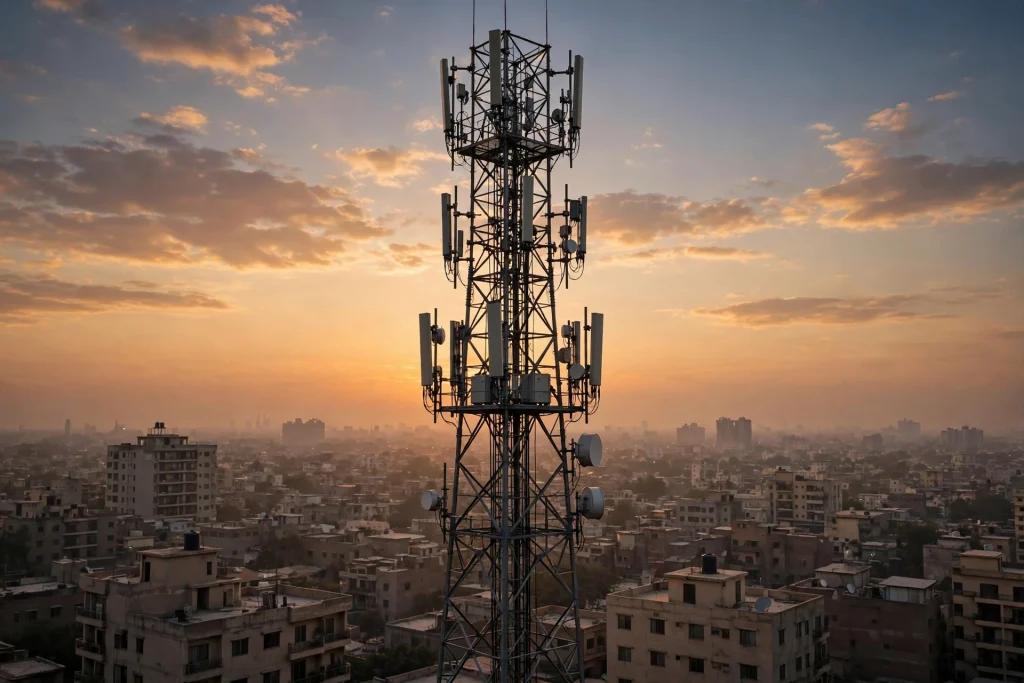
If you have been waiting for 5G to arrive in your city, the latest news from Islamabad is a mix of progress and patience. The government has told the National Assembly that 5G services are currently available in 24 cities across Pakistan, but a nationwide rollout will take another two years. The priority, officials say, is to stabilise 5G in the cities where it already exists before expanding to new areas.
That single statement answers the question many mobile users keep asking: is 5G here or not? The honest answer is that it is here, but only in pockets. If you live in one of the 24 cities, you may see a 5G signal in some areas. If you live anywhere else, your phone will keep running on 4G, and in some places it may still fall back to 2G. This guide explains the full city list, how many 5G sites each operator has built, why your phone keeps switching networks, and what the two-year timeline really means.
The headline: 24 cities now, nationwide in two more years
On Friday 23 October 2026, the government told the National Assembly that nationwide 5G rollout will take another two years. Parliamentary Secretary for Information Technology Sabeen Ghouri said 5G services were available in 24 cities and that work was under way to improve services before expanding coverage to more cities.
It is important to read that timeline exactly as it was given. Officials said “another two years” — they did not announce a calendar date, and no source has published a fixed deadline. So this article does not treat any specific month or year as the official finish line. The two-year figure is a duration, not a date on the calendar.
The reason for the wait is also clear from the government’s own explanation: the network has to become stable in the first 24 cities before it is pushed further. Lawmakers raised complaints during the same session about slow internet and patchy coverage in places outside the 5G footprint, which shows why rushing the expansion without fixing the basics would not help users.
The full list of 24 cities with 5G
Both reports that published the list agree on the same 24 cities. They are: Islamabad, Karachi, Lahore, Rawalpindi, Faisalabad, Peshawar, Quetta, Multan, Gujranwala, Sialkot, Sheikhupura, Hyderabad, Abbottabad, Attock, Jhelum, Kasur, Kohat, Mardan, Rahim Yar Khan, Sahiwal, Sukkur, Swabi, Chitral and Gujrat.
If your city is on this list, 5G exists there in principle. But “in your city” does not mean “on your street”. 5G sites are installed in specific locations, usually busy commercial areas, city centres and high-traffic zones first. A city can be on the list while large parts of it still have no 5G signal at all. That is why checking your own area matters more than checking the city name.
How many 5G sites are there in each city?
A total of 1,782 5G sites have been deployed across the 24 cities, according to figures cited by IT Minister Shaza Fatima Khawaja. Site counts have been published for ten cities so far. Here they are:
| City | Reported 5G sites |
|---|---|
| Karachi | 385 |
| Lahore | 373 |
| Islamabad | 276 |
| Faisalabad | 144 |
| Peshawar | 122 |
| Rawalpindi | 108 |
| Multan | 103 |
| Sialkot | 87 |
| Quetta | 65 |
| Sheikhupura | 55 |
These ten cities add up to 1,718 sites, which leaves 64 sites spread across the other 14 cities on the list. Site counts for those 14 cities — Gujranwala, Hyderabad, Abbottabad, Attock, Jhelum, Kasur, Kohat, Mardan, Rahim Yar Khan, Sahiwal, Sukkur, Swabi, Chitral and Gujrat — have not been published, so this article does not guess them. The pattern is still clear: the biggest cities got the most sites, and the smaller cities on the list share a much smaller number between them.
How many 5G sites does each operator have?
The 1,782 sites are split between three named operators:
| Operator | Reported 5G sites |
|---|---|
| Jazz | 1,015 |
| Zong (CMPak) | 640 |
| Ufone | 127 |
| Total | 1,782 |
The arithmetic checks out: 1,015 plus 640 plus 127 equals exactly 1,782. Jazz has built well over half of all 5G sites so far, Zong accounts for roughly a third, and Ufone for a much smaller share.
One gap in the published figures deserves a plain note. The reports name only Jazz, Zong and Ufone, and their counts already add up to the full total of 1,782. No site count for Telenor was stated in those reports, so this article does not assign Telenor a figure and does not describe its count as zero. If you are a Telenor user, the published numbers simply do not tell you how many 5G sites your operator has built.
Separately, Jazz had earlier set a target of 2,500 sites by the end of 2026. That is an August 2026 company claim, reported by Mettis and The News on 27 August, not a fresh October fact — so treat it as a company target from two months ago, not as a confirmed current position.
How Pakistan got to 5G: auction, licences and the four-phase plan
The current rollout did not start in October. It began with Pakistan’s largest-ever spectrum auction in March 2026, when operators acquired 480 MHz of additional spectrum for 509 million dollars, taking their combined holdings from 274 MHz to 754 MHz. Licences were signed on 19 March 2026, and commercial rollout began from 20 March 2026 under a four-phase federal plan.
Phase one covers the federal and provincial capitals. Later expansion follows what officials describe as business plans, meaning operators extend where demand and commercial viability justify the investment. No per-phase dates have been published, so there is no official schedule saying which cities get 5G in which month. That absence of dates is itself worth knowing: any article or social media post that claims a specific launch month for your city is guessing unless it cites an operator announcement.
The licences also carry an obligation that matters for everyday users. Under the NGMS licences, operators must improve 4G as well as build 5G. That is relevant because most Pakistanis will keep using 4G for a long time, even in cities where 5G exists.
Behind the mobile sites, the supporting infrastructure has also grown. The IT minister told a panel in Seoul on 20 October 2026 that more than 234,000 kilometres of fibre-optic cable have been deployed nationwide, and that Pakistan connects to international networks through six submarine cables with combined capacity of more than 17 terabits per second. Fibre matters because every 5G site needs a high-capacity connection back to the core network; without it, the wireless speed on your phone cannot reach its potential.
Why your phone still drops to 4G or 2G
One of the most common complaints from users in 5G cities is that their phone shows 5G for a few minutes and then drops back to 4G, or even 2G. There are several ordinary reasons for this, and none of them means your phone is broken.
First, 5G coverage is still a patchwork. A PTA second-quarter 2026 figure cited in the same October reporting found that 5G was available for only 3.95 percent of users’ connected time. That number explains the experience perfectly: even in a listed city, a user spends the vast majority of connected time on older networks because 5G simply does not reach most places yet.
Second, your phone must actually support 5G, and not just in name. It needs to support the frequency bands your operator uses for 5G in Pakistan. An imported phone, or an older model marketed as “5G ready” in another country, may not connect to local 5G at all.
Third, your plan and settings matter. Some plans need a 5G add-on or a specific package, and the phone’s network mode must allow 5G. If the setting is fixed to 4G only, or to an automatic mode that prefers a stronger 4G signal, the phone will stay on 4G even next to a 5G site.
Fourth, moving matters. 5G signals, especially at higher frequencies, cover shorter distances and struggle more with walls than 4G. Walking indoors, entering a basement or driving out of a covered pocket is often enough for the phone to hand over to 4G. That handover is normal network behaviour, not a fault.
The 5G phone cost barrier
Even where 5G is available, many users cannot use it because their phone does not support it. According to a figure cited by the IT minister, the cheapest locally available 5G handset costs around Rs 36,000. No specific model was named with that figure, so treat it as a rough price floor to check against in the market, not as a recommendation for a particular phone.
That price is a real barrier for a large part of the market. A user who bought a good 4G phone for Rs 25,000 or Rs 30,000 in the last two years would need to spend more than the price of that phone again just to get 5G capability. For many households, that upgrade makes sense only when the old phone needs replacing anyway.
Before you buy a phone for 5G, check three things. First, confirm that 5G actually covers your home and workplace, not just your city name. Second, confirm the phone supports the local 5G bands — ask the seller or check the official specifications for Pakistan. Third, confirm with your operator whether your current plan includes 5G or needs a change. Buying the phone first and discovering afterwards that your area has no 5G signal is the most common and most avoidable disappointment.
What “two more years” really means for you
The two-year timeline should be read as a sequencing statement, not a promise about your street. The order is: stabilise 5G in the 24 cities, then expand. That means users in the existing 24 cities should see coverage deepen — more sites, fewer dead zones, more consistent signals — before users in new cities see their first 5G site.
If your city is already on the list, the practical question is not “when does 5G arrive” but “when does it reach my area and become reliable”. If your city is not on the list, the honest answer is that no official date exists for it, and the expansion order will follow operator business plans rather than a published calendar.
It also means 4G remains the real workhorse network for the next two years and beyond. The licence requirement to improve 4G alongside 5G is good news for the majority of users, because a better 4G connection today is worth more than a 5G icon that appears for a few minutes a day.
How to check 5G coverage in your area
Follow these steps before spending money on a new phone or changing your plan:
- Check whether your city is on the 24-city list above. If it is not, 5G is not officially available to you yet.
- If your city is listed, check your operator’s coverage map or app for 5G coverage in your specific neighbourhood. City-level lists do not show street-level coverage.
- Check your phone’s specifications for 5G support on local bands, and make sure the network mode in settings allows 5G.
- Confirm with your operator whether your plan includes 5G access, and whether your SIM needs any update.
- Test in a known covered location, such as a busy commercial area in your city, before concluding that your phone or SIM has a problem.
- If 5G is advertised in your area but consistently absent, raise it with your operator first and keep the complaint number. If the operator does not resolve it, you can escalate through the PTA’s complaint channels.
If none of these steps bring up a 5G signal, the most likely explanation is simply that no 5G site covers your location yet — even inside a listed city. That is a coverage fact, not a fault in your phone.
Speed claims: what the numbers actually say
Two different speed figures appear in the October reporting, and they must not be mixed up. The IT minister, speaking in Seoul on 20 October 2026, said 5G was delivering average speeds of 130 Mbps. That is a claimed average for 5G connections where the service is available.
A separate set of figures comes from PTA second-quarter 2026 data cited in the same week’s reporting: 4G users averaged 18.9 Mbps, and 5G was available for only 3.95 percent of connected time. These are different measurements. The 130 Mbps figure describes 5G where it exists; the 3.95 percent figure describes how rarely most users actually get it. Together they tell a consistent story: fast where available, but available only in small pockets so far.
That is also why the speed debate in the National Assembly sounded frustrated. Lawmakers were not disputing that 5G can be fast. They were pointing out that most users experience the older networks most of the time, and that those networks still have coverage and reliability problems. Until the pockets join up into continuous coverage, the average user’s experience will be set by 4G, not by the 5G headline speed.
What to watch next
Three things will show whether the two-year timeline is on track. First, whether site counts in the 24 cities keep growing, especially in the 14 smaller cities whose counts have not been published. Second, whether operators announce per-phase dates or new city additions, which would turn the current general timeline into a concrete schedule. Third, whether the share of connected time on 5G rises above that 3.95 percent figure in future PTA data. That single percentage is probably the best public yardstick for real progress, because it measures what users actually experience rather than what is claimed on paper.
For now, the position is simple. 5G is real in 24 cities, thin in most of them, and absent everywhere else. Nationwide coverage is, by the government’s own account, another two years away — and that is a duration to watch, not a date to circle.
The National Assembly statement, the 24-city detail and the two-year timeline were reported by ProPakistani on 24 October 2026, with matching coverage from Business Recorder the same day.
Also read: Which Network Is Fastest in Your City? PTA’s 2026 Drive Test Results — and How to Pick Before You Port and Weak Signals or Dropped Calls? How to Complain So Your Operator and PTA Actually Fix It
FAQs
Is 5G available in my city?
Check the 24-city list in this article: Islamabad, Karachi, Lahore, Rawalpindi, Faisalabad, Peshawar, Quetta, Multan, Gujranwala, Sialkot, Sheikhupura, Hyderabad, Abbottabad, Attock, Jhelum, Kasur, Kohat, Mardan, Rahim Yar Khan, Sahiwal, Sukkur, Swabi, Chitral and Gujrat. If your city is not listed, 5G is not officially available there yet. If it is listed, check your operator’s coverage map for your neighbourhood, because city-level availability does not mean street-level coverage.
When will 5G reach the whole country?
The government told the National Assembly on 23 October 2026 that nationwide rollout will take another two years, with the current 24 cities stabilised first. No calendar deadline was announced, and no per-phase dates have been published, so no specific month or year should be treated as the official finish date.
Why does my 5G phone show 4G most of the time?
Because 5G coverage is still a patchwork. PTA second-quarter 2026 data cited in October reporting found 5G available for only 3.95 percent of users’ connected time. Outside a covered pocket, your phone hands over to 4G or 2G automatically. Also check that your phone supports local 5G bands, that your network mode allows 5G, and that your plan includes 5G access.
Do I need a new phone or SIM for 5G?
You need a phone that supports 5G on the bands your operator uses in Pakistan; a 4G phone cannot connect to 5G. According to a figure cited by the IT minister, the cheapest locally available 5G handset costs around Rs 36,000, with no specific model named. Check with your operator whether your SIM and plan need any update, and confirm 5G coverage in your area before buying.