
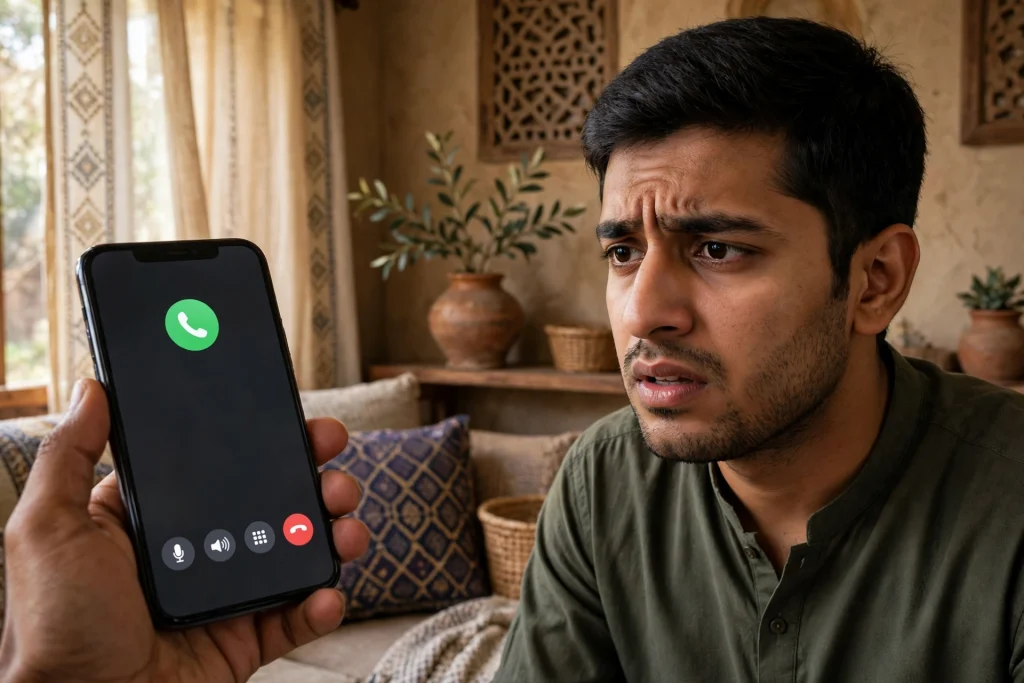
The claim in your WhatsApp groups
You have probably seen the post by now. It arrives as a forwarded message or a short video clip, often in Urdu, with a headline along these lines: “From 1 November, the caller’s name will also appear on mobile phones.”
It sounds believable. It sounds useful. It sounds like exactly the kind of change that would stop unknown-number fraud, because you would see who is calling before you pick up. That is precisely why it spread so fast in Pakistan in mid-October 2026.
There is only one problem with it. The claim, as it is being shared in Pakistan, leaves out the single most important word: India.
The reported announcement behind the viral posts concerns India, not Pakistan. No order from Pakistan’s telecom regulator says that Pakistani mobile networks must start displaying callers’ registered names from 1 November. If you are waiting for your phone to suddenly start showing the registered name of every unknown caller on 1 November, you are waiting for something that has not been announced in this country.
This article explains, in plain language, where the claim came from, why it does not apply to Pakistan, what will actually happen on 1 November, and how to spot the next viral telecom claim before it fools you or costs you money.
What the viral posts actually say
The posts circulating in Pakistan in mid-October 2026 share a simple message: from 1 November, the caller’s name will appear on the phone screen along with the number. Some versions of the message present this as a general mobile-phone change, as if it were a worldwide update or a change to how phones work everywhere.
That framing is where the confusion starts. A mobile phone does not decide on its own what name to show for an unknown number. Today, your phone shows a name only when you have saved that number in your contacts. For an unsaved number, it shows the number itself, and nothing more, unless you are using a separate caller-identification app that guesses the name from its own database.
For a network-wide change, where every phone on every network automatically shows the registered name of an unknown caller, somebody has to order it. A regulator has to tell the operators to build it, and the operators have to connect their systems so that one network can ask another network for the caller’s registered name when a call comes in. That is a decision for a country’s own regulator and its own operators. It cannot be imported by a forwarded message.
The one missing detail: whose announcement is it?
The issuing authority in the original story is India’s Department of Telecommunications, usually shortened to DoT. The DoT is an Indian government department. It makes rules for telecom operators in India.
Pakistan’s telecom regulator is a different body with a different name: the Pakistan Telecommunication Authority, or PTA. The PTA regulates Jazz, Zong, Ufone, Telenor and the other operators that serve Pakistani customers.
A directive from India’s DoT does not automatically apply to Pakistani networks. This is the basic point that the viral posts skip, and it is the whole story in one sentence. India can order its own operators to do something. Pakistan’s operators answer to Pakistan’s regulator. Until the PTA, or an individual Pakistani operator, announces a comparable change, there is no Pakistan version of the rule, no matter how many times the claim is forwarded.
This kind of mix-up happens more often than people realise. News travels across borders instantly, but rules do not. A headline written about one country gets copied, translated, shortened for a social-media post, and shared in another country, and somewhere along the way the country name falls out. By the time the post reaches your family group, it reads like a local announcement. It is not.
What the PTA has and has not said
This is the part that matters most, so let us be exact about dates.
On 17 October 2026, a fact-check of the viral claim found no PTA notification for a comparable nationwide order requiring Pakistani operators to display callers’ registered names from 1 November. No corresponding PTA notification was identified in the material supplied for that fact-check. In other words, as of 17 October, the claim that a Pakistan launch was coming on 1 November was unsubstantiated.
That date matters, because a fact-check is a snapshot, not a permanent guarantee. A regulator can always announce something new tomorrow. So before writing this article, the position was re-checked on 26 October 2026: searches for PTA announcements after 17 October turned up PTA items on other subjects, including its October monitoring of network quality and a draft framework for radio licences, but nothing about a caller-name display order for Pakistani networks. No PTA caller-name order for 1 November has surfaced since the fact-check either.
To be fair and precise, this is what can honestly be said today: as of 26 October 2026, there is no verified PTA order requiring Pakistani operators to display callers’ registered names from 1 November, and no Pakistani operator announcement of such a launch has been verified either. If the PTA or an operator announces something in future, that announcement, not a forwarded post, will be the real news, and this article’s position should be updated from it.
That careful wording is deliberate. It is the difference between a fact and a guess. “No order has been found” is a checkable statement about the public record. “There will never be such a rule” would be a prediction, and nobody can honestly make that prediction. What readers need to know right now is simpler: nothing has been announced, so nothing is coming on 1 November on the basis of this claim.
India versus Pakistan: the comparison in one table
| Question | India (the reported announcement) | Pakistan |
|---|---|---|
| Which authority issued it? | India’s Department of Telecommunications (DoT) | No comparable order from the PTA has been verified |
| Who does it bind? | Telecom operators in India | Nobody in Pakistan, because no such order exists here |
| Does it apply to Jazz, Zong, Ufone or Telenor in Pakistan? | No | No |
| What would a real Pakistan change need? | Not relevant | An official PTA or operator announcement in Pakistan |
| Should you expect a change on 1 November in Pakistan? | The date belongs to the Indian report | No, not on the basis of this claim |
Keep this table in mind whenever a similar claim appears. The first question is always: which authority, and in which country? If the post cannot answer that question, the post is not a reliable announcement.
So what will actually happen on 1 November in Pakistan?
Nothing, as far as caller-name display is concerned. Your phone will behave exactly as it does today.
If a number is saved in your contacts, you will see the name you saved. If a number is not saved, you will see the number only, unless you use a caller-identification app, in which case you will see whatever that app guesses from its own records. That guess is not an official registered name, and it can be wrong, out of date, or deliberately faked by a scammer who has registered a convincing name somewhere.
No setting will magically appear on your phone on 1 November. No operator will silently switch the feature on for you. No update will change how unknown numbers appear, because no such update has been announced for Pakistan.
That is actually useful news. It means you do not need to do anything, change any setting, install anything, or pay anyone before 1 November. Anyone who tells you otherwise is either confused by the same viral post or trying to sell you something.
The scam risk hiding inside the viral claim
Every viral claim like this one creates a second problem: the people who exploit it. When millions of people believe a new phone feature is coming, scammers have a ready-made story to sell.
Watch out for these versions of the trick:
- “Activate caller-name display” apps. An app that promises to switch on the official 1 November feature in Pakistan is promising something that does not exist. At best it is an ordinary caller-ID app dressed up in official-sounding language. At worst it is harvesting your contacts, your call history, or your personal data.
- “Activation” fees. There is no official fee to activate a feature that has not been announced. Anyone asking for payment, mobile balance, or a bank transfer to “register” your number for caller-name display is running a scam.
- Fake PTA or operator messages. A message claiming to be from the PTA or from Jazz, Zong, Ufone or Telenor, telling you to click a link or call a number to enable the feature, should be treated with suspicion. Real regulator and operator announcements do not arrive as a link in a forwarded message asking you to act urgently.
- Fake “official” notices. Pakistan has already seen fake PTA notices circulated on social media before, including notices that were later confirmed as false by the regulator itself. A screenshot of a notice is not proof. A notice is only real if it appears on the regulator’s or operator’s own official channels.
The rule is simple: if a feature has not been announced by the PTA or your operator, nobody can sell you early access to it. Early access to a non-existent feature is a scam by definition.
What to do if you already installed something or paid someone
Do not panic, but do act quickly.
First, uninstall any app you installed purely because it promised to activate caller-name display for 1 November. Then check what permissions it had, especially access to your contacts, call logs, messages, and device settings, and think about what it may have collected while it was installed.
Second, if you paid money to anyone for “activation” or “registration,” keep the receipt, the transaction message, and the number or account you paid. Report the payment to your mobile wallet or bank straight away and ask what reversal or complaint options exist. The sooner you report, the better your chances.
Third, if the app or message asked you for a code sent to your phone, a password, or a one-time password, change the passwords for the affected accounts and check those accounts for unfamiliar activity. Never share a verification code with anyone who asks for it by call or message, no matter how official they sound.
Fourth, report the scam. You can report a fraudulent number or message to your operator, and fraud can be reported to the National Cyber Crime Investigation Agency on its helpline 1799. A report does not guarantee your money back, but it helps investigators track the scam and warn others.
Finally, tell the person who forwarded the claim to you. Most people who share these posts are not scammers; they genuinely believe they are helping. A short reply, “This one is about India, not Pakistan, and the PTA has not announced it here,” stops the chain far more effectively than arguing about it.
How to check the next viral telecom claim in two minutes
You do not need to become a fact-checker. You need a habit. Run through these five checks before you believe or forward the next “from next month” telecom claim:
- Which country? Look for the country name in the original report, not just in the forwarded post. If the post never names a country, that is itself a warning sign.
- Which authority? A real rule names its regulator. In Pakistan, that means the PTA. In India, it means the DoT. If the authority named is not Pakistan’s, the rule is not Pakistan’s.
- Where is the original announcement? A genuine regulator announcement appears on the regulator’s own website or official social-media accounts, and is then reported by established news outlets with the announcement quoted or linked. A screenshot with no source is not an announcement.
- Has your operator said anything? A nationwide network change would be announced by Jazz, Zong, Ufone and Telenor as well, in their apps, on their websites, or by SMS from their official short codes. Silence from all four operators is strong evidence that nothing is launching.
- Is somebody selling you something? The moment a claim comes with an app to install, a fee to pay, or a link to click urgently, stop. Real regulator rules do not need you to buy early access.
If a claim fails even one of these checks, do not forward it. Forwarding an unverified claim is how a foreign announcement becomes a local panic.
What a real Pakistan caller-name rule would look like
It is worth picturing, because it makes the fake version easier to recognise.
A real Pakistan change would start with a PTA announcement, published through the PTA’s own channels, naming the requirement, the operators covered, and the date. Operators would then explain, in their own announcements, how the feature would work on their networks, whether customers needed to do anything, and what would appear on screen for saved numbers, unsaved numbers, and international calls. News outlets would report the PTA announcement with its date and details, and different outlets would agree on the basics because they would all be quoting the same official source.
None of that has happened for caller-name display in Pakistan. There is no PTA announcement to quote, no operator explanation to link to, and no agreed set of details, because the only detailed announcement in circulation belongs to another country.
That absence is the evidence. In telecom regulation, silence from the regulator is not a mystery to solve; it is the answer. If the PTA had ordered a nationwide change for 1 November, it would have said so loudly and publicly, weeks in advance, because operators would need time to build it.
Unknown calls: what you can actually do today
The viral claim spread because it promises something people genuinely want: knowing who is calling before answering. You cannot get the promised feature today, but you can protect yourself against unknown calls with steps that already work.
Let unknown numbers ring out if you are not expecting a call. A genuine caller, such as a bank, a courier, or a government office, will either leave a message or can be reached back on their official number, which you should find yourself rather than trusting the number shown on your screen.
Never trust a displayed name alone, even a familiar one. Scammers can spoof numbers and names, and a caller-identification app can show a name that a scammer has planted. If a caller claims to be your bank, the police, or a government department and asks for money, a password, or a code, hang up and contact the organisation directly on a number you already trust.
Save the numbers you actually use, with clear names, so that genuine calls are easy to recognise. Block and report numbers that repeatedly harass you or try to scam you. And if you suffer persistent problems with dropped calls, weak signals, or a number that will not stop calling, your operator’s complaint channel comes first, and the PTA’s complaint route is the next step if the operator does not resolve it.
None of this requires a new feature, a new app, or a payment. It requires only the healthy suspicion that the viral claim, ironically, was trying to replace: do not trust an unknown caller just because a screen tells you a name.
The bottom line
The viral claim is not a lie from start to finish. It is a real report about another country, stripped of its country name and shared as if it were local news. That is what makes it so effective, and so hard to argue against in a family group. The post feels true because part of it is true: somewhere, a regulator really did announce a caller-name display plan for 1 November. That somewhere is India. That regulator is India’s DoT. Pakistan’s regulator, the PTA, has issued no comparable order, and a re-check on 26 October 2026 found nothing since the 17 October fact-check to change that position.
So keep your phone exactly as it is. Do not install an “activation” app. Do not pay an “activation” fee. Do not forward the claim. And the next time a post promises a big mobile change “from next month,” ask the one question that would have stopped this one: which country, and which authority? If the answer is not Pakistan and the PTA, the post is not about you, no matter how confidently it is written.
The fact-check behind this article is Daily Pakistan, which published its check of the viral claim on 17 October 2026 and identified India’s Department of Telecommunications, not the PTA, as the issuing authority.
FAQs
Will caller names appear on my phone in Pakistan from 1 November 2026?
No, not on the basis of this viral claim. The reported announcement concerns India and its Department of Telecommunications. As of 26 October 2026, no PTA order requiring Pakistani operators to display callers’ registered names from 1 November has been verified, so your phone will behave exactly as it does today.
Why did so many posts in Pakistan say this was happening here?
Because the posts shared the headline without clearly stating that the announcement concerned India. Once the country name fell out of the message, readers in Pakistan naturally assumed the change applied to them. The missing detail was the issuing authority: India’s DoT, not Pakistan’s PTA.
Do I need to install an app or change a setting to get caller-name display?
No. There is no verified Pakistan setting to enable, because no such feature has been announced here. Any app or message that promises to “activate” the 1 November feature in Pakistan should be treated as a scam, especially if it asks for payment, personal data, or a verification code.
What should I do if a real caller-name rule is announced in Pakistan later?
Wait for the announcement itself: a PTA statement on its own official channels, confirmed by your operator, naming the requirement and the date. Until that announcement exists, treat every forwarded claim as unverified, and never pay anyone or install anything on the strength of a social-media post alone.
Also read
Weak Signals or Dropped Calls? How to Complain So Your Operator and PTA Actually Fix It
All Networks Check Codes: Jazz, Zong, Telenor and Ufone in One List