
If you are thinking about switching from a plastic SIM card to an eSIM in Pakistan, the first question you will ask is a simple one: how much does it cost? The answer should be simple too, because the telecom regulator has set a clear maximum price. In practice, however, the answer gets messy the moment you open the mobile operators’ own websites, because different pages from the same company show different prices.
This article clears up that confusion. It explains the price cap set by the Pakistan Telecommunication Authority (PTA), what Jazz, Zong and Ufone actually show on their pages, how to convert your existing number to an eSIM, and one important step about your phone’s IMEI numbers that many people miss — and that can leave your new eSIM showing no service.
What is an eSIM, in simple words?
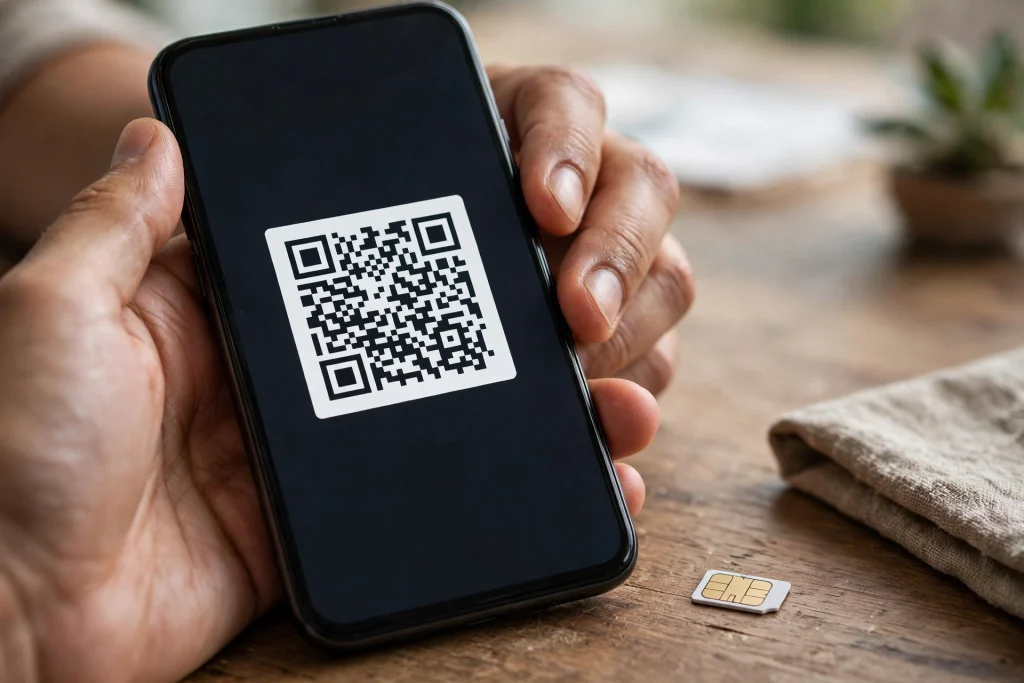
An eSIM is a digital SIM that lives inside your phone instead of a small plastic card. You do not insert anything into the phone. Instead, your mobile operator gives you a QR code, you scan it with your phone’s camera through the settings menu, and your mobile number becomes active on the phone’s built-in chip.
Your number, calls, text messages and mobile data all work the same way as before. The only difference is the form: there is no physical card to lose, break or swap. Many newer phones can also store more than one eSIM profile, which is useful if you use two numbers, for example one for work and one for personal use.
Not every phone supports eSIM, though. Most recent iPhones and flagship Android phones do, but many mid-range and budget phones do not. Before you pay anything or travel to a franchise, check whether your exact phone model supports eSIM. The operator’s staff can confirm this for you, or you can check your phone’s settings for an “Add eSIM” or “Add Cellular Plan” option.
The PTA cap: Rs 1,500 is the maximum, not a suggestion
In August 2026, PTA fixed a maximum retail price of Rs 1,500 for the issuance of an eSIM and for converting a physical SIM into an eSIM. This cap applies across Pakistan, Azad Jammu and Kashmir, and Gilgit-Baltistan. It came into effect on 17 August 2026.
That word “maximum” matters. It means no operator should charge you more than Rs 1,500 for the eSIM itself. An operator is allowed to charge less, but not more. If a franchise or service centre quotes you a higher figure for the eSIM fee, that quote goes against the cap, and you are right to question it.
PTA’s decision also included a second benefit that matters a lot if you change phones often. Moving your eSIM profile from one compatible phone to another is free for up to ten migrations. Before this rule, the number of free transfers varied from operator to operator, which caused a lot of confusion. Now the rule is the same for everyone: ten free transfers.
Keep one detail in mind, though. The Rs 1,500 cap covers the eSIM issuance or conversion fee. It does not necessarily cover the price of a special or “golden” number if you are buying a brand-new number with a fancy pattern. Jazz, for example, says its Rs 1,500 figure excludes standard number charges. That is why you should always ask the agent to tell you the full total before you hand over your CNIC for biometric verification — so there are no surprises at the counter.
What each operator actually charges: the conflicting figures
Here is where things get confusing, and honesty requires us to show the conflict instead of hiding it. The operators’ own pages do not agree with each other, and in two cases, a single operator’s pages disagree with themselves.
| Operator | What its pages show | Where to get it |
|---|---|---|
| Zong | Rs 1,500 | Zong customer service centre or franchise |
| Jazz | Rs 1,500 on its main eSIM page (as of 24 October 2026), but its help pages still show Rs 2,000, and one FAQ page shows Rs 5,000 for a new number | Jazz Experience Centre, franchise or eligible retailer |
| Ufone | Rs 1,500 in the price section of its page, but Rs 2,000 in the FAQ and terms sections of the same page | Service centre, franchise, self-service booth or joint shop |
| Telenor | Price could not be confirmed — its eSIM page could not be read | Ask at a Telenor franchise |
Zong is the cleanest case: its eSIM page says Rs 1,500, which matches the PTA cap exactly. If you are a Zong customer, the price question is straightforward.
Jazz is the messiest case. Its main eSIM page said Rs 2,000 when it was read on 19 October 2026, and Rs 1,500 when it was read again on 24 October 2026 — so the main page has now been updated to match the cap. But two of Jazz’s own help pages were not updated at the same time. The Process Help Center still says Rs 2,000 for both new and existing numbers, and the FAQ page says Rs 2,000 for an existing number and Rs 5,000 for a new one. The Rs 5,000 figure most likely includes number charges for a new number, but Jazz does not spell that out clearly, so a customer reading the FAQ could easily believe the eSIM itself costs Rs 5,000.
Ufone has a similar problem on a smaller scale. Its page says Rs 1,500 in the price section, for both a new customer and a physical SIM conversion, but Rs 2,000 for a new sale in its FAQ and terms sections. Same company, same page, two different prices.
The practical lesson is simple: do not treat any single web page as the final word. The PTA cap of Rs 1,500 is your anchor. When you visit the franchise, say clearly that you know the cap is Rs 1,500, and ask the agent to confirm the total in writing on your receipt before you pay.
Why do the operator pages still show old prices?
There is no mystery here, and no need to assume bad intentions. Large company websites have many pages, written at different times by different teams, and old pages often stay online long after a rule changes. PTA’s cap only took effect on 17 August 2026, and some help and FAQ pages simply have not been updated since then.
That is also why the main eSIM pages are more reliable than older help pages: Jazz’s main eSIM page was updated between 19 and 24 October 2026, while its help pages were not. When pages disagree, the newest page — and the regulator’s cap — should carry more weight than an old FAQ.
Still, the confusion is real for ordinary customers, and it is the operators’ job to fix it. Until they do, the safest approach is the one in this article: know the cap, confirm the total at the counter, and keep your receipt.
How to convert your existing number to an eSIM
The good news is that conversion is available on Jazz, Zong and Ufone, and the process is similar on all three. You keep your existing number, and your current services and tariffs carry over — you do not lose your package or your balance just because the SIM becomes digital. Here is the general process:
- Check that your phone supports eSIM. If it does not, conversion is pointless, so confirm this first.
- Visit the operator’s service centre, franchise or eligible retailer with your original CNIC and your current SIM.
- Ask for eSIM activation or conversion of your existing number.
- Complete biometric verification. This step is required — your fingerprint is checked against your CNIC record, and the process cannot move forward without it.
- You will receive a QR code, usually printed on a voucher. Do not share this QR code with anyone; it is tied to your number.
- Connect your phone to the internet, open the mobile network settings, and choose the option to add a cellular plan or eSIM. On an iPhone, this is under Settings, then Cellular, then Add Cellular Plan. On a Samsung phone, it is under Settings, then Connections, then SIM Card Manager, then Add Mobile Plan.
- Scan the QR code with your phone’s camera. Jazz says the eSIM is active within about five minutes of scanning.
Once the eSIM is active, your old physical SIM stops working. That is normal and expected — the same number cannot stay active on two SIMs at once. Do not throw the old SIM away in a panic if the eSIM has not activated yet, though. Wait until you see the network signal on the eSIM before you consider the job done.
The IMEI step you must not skip: register BOTH IMEIs
This is the most important part of this article, and the step most people have never heard of. Every phone has IMEI numbers — unique codes that identify the device on mobile networks. A phone with a physical SIM slot and an eSIM has two IMEIs: IMEI 1 for the physical SIM slot and IMEI 2 for the eSIM slot.
Both Jazz and Zong state the same critical instruction: you must register BOTH IMEIs, or your eSIM may not work. If only one IMEI is registered, the eSIM slot can show no service, and your phone may even risk being blocked by PTA’s Device Identification, Registration and Blocking System (DIRBS), which checks whether a device’s IMEIs are registered in Pakistan.
Here is exactly what to do, as stated by the operators:
- Send both IMEI numbers by SMS to 8484. You can find your phone’s IMEIs by dialling *#06# on the phone, or in the phone’s settings under About Phone.
- Email screenshots showing IMEI 1 and IMEI 2 to [email protected] for whitelisting.
Do this as soon as your eSIM is active, and do not skip the email step just because the SMS went through. The two steps serve different purposes, and Jazz and Zong both list them together for a reason. If your eSIM shows no service after activation, an unregistered second IMEI is the first thing to check — before you blame the network or the QR code.
What happens if you factory reset your phone?
This is another point where Jazz and Zong give different answers, so be careful.
Jazz says that if you factory reset your phone, the eSIM is removed, and you will need a new QR code. That means a trip back to the franchise and, potentially, another fee — so check the current policy at the counter before you reset.
Zong says its eSIM code can be re-scanned after a reset, which is much more forgiving.
Either way, the safe habit is the same: back up your phone fully before any factory reset, keep your original QR code voucher somewhere safe, and never reset your phone as a first step when troubleshooting. If you are resetting because of a problem, try restarting the phone and checking the IMEI registration first — a reset that wipes your eSIM will only add a new problem on top of the old one.
What about Telenor?
Telenor’s eSIM page could not be read when the research for this article was done — repeated requests to the page were blocked. For that reason, this article does not print any Telenor eSIM price, and you should not trust any article that invents one.
If you are a Telenor customer, the honest advice is this: visit a Telenor franchise in person, ask for the eSIM price, and expect it to be within the PTA cap of Rs 1,500. If you are quoted more than Rs 1,500 for the eSIM fee itself, ask the agent to explain the extra amount and to show you the breakdown. The cap applies to all operators, not just the three named in this article.
What to do if you are quoted more than Rs 1,500
First, stay calm and polite — the person at the counter may simply be reading an outdated page, just like the websites. Second, state the facts plainly: PTA has capped the eSIM issuance and conversion fee at Rs 1,500 since 17 August 2026, and transfers between phones are free for up to ten migrations. Third, ask for the total to be confirmed before biometric verification, and check your receipt afterwards to make sure the eSIM fee line matches what you agreed.
If the franchise still insists on a higher eSIM fee, you have two sensible options: try another franchise or service centre of the same operator, or raise the matter with PTA’s complaint channels. Do not pay a fee you believe is wrong just to get the process over with, because getting a refund afterwards is always harder than refusing an overcharge at the counter.
Is an eSIM worth it for you?
An eSIM is worth it if your phone supports it and you value convenience: no tiny card to handle, no tray to open, and the ability to carry two numbers on one phone. It is especially useful for travellers and for people who switch between a work number and a personal number.
It is not worth rushing into if your phone does not support eSIM, if you frequently factory reset your phone, or if you swap your SIM between phones often — in that last case, remember that transfers are free for ten migrations, but a physical SIM is still simpler to move by hand. Weigh the convenience against the one-time fee of up to Rs 1,500, and make the decision on your own usage, not on the hype.
The bottom line is this: the legal maximum for an eSIM in Pakistan is Rs 1,500, Zong’s page matches it, Jazz’s main page now matches it while its help pages lag behind, and Ufone’s own page contradicts itself. Know the cap, confirm the price at the counter, complete your biometric verification, register both IMEIs, and keep your QR code safe. Do those five things, and your switch to eSIM should be smooth.
Before the FAQs, here is the source behind the price figures in this article: the comparison of Jazz, Zong and Ufone eSIM pages, including the conflicting figures and the dates they were read, comes from Pakera, whose eSIM price guide was updated around 24 October 2026 and checked the operators’ pages on 19 and 24 October 2026.
FAQs
What is the eSIM price in Pakistan in 2026?
PTA has capped the eSIM issuance and conversion fee at a maximum of Rs 1,500, in effect since 17 August 2026. Zong’s page shows Rs 1,500 and Jazz’s main eSIM page now shows Rs 1,500, but older Jazz help pages still show Rs 2,000 and Rs 5,000, and Ufone’s page shows both Rs 1,500 and Rs 2,000 in different sections. Always confirm the total at the counter before paying.
Can I convert my existing Jazz, Zong or Ufone number to an eSIM?
Yes. All three operators allow you to convert your existing number to an eSIM, and your services and tariffs carry over. You will need biometric verification with your original CNIC, and your physical SIM will stop working once the eSIM is active.
Why does my eSIM show no service after activation?
The most common cause in Pakistan is an unregistered second IMEI. Phones with eSIM have two IMEIs, and both must be registered: send both IMEIs by SMS to 8484 and email screenshots of IMEI 1 and IMEI 2 to [email protected]. If only one IMEI is registered, the eSIM slot may show no service.
What happens to my eSIM if I factory reset my phone?
It depends on your operator. Jazz says the eSIM is removed by a factory reset and a new QR code is needed, while Zong says its code can be re-scanned. Back up your phone and keep your QR code voucher safe before any reset, and check your operator’s current policy at a franchise if you are unsure.