
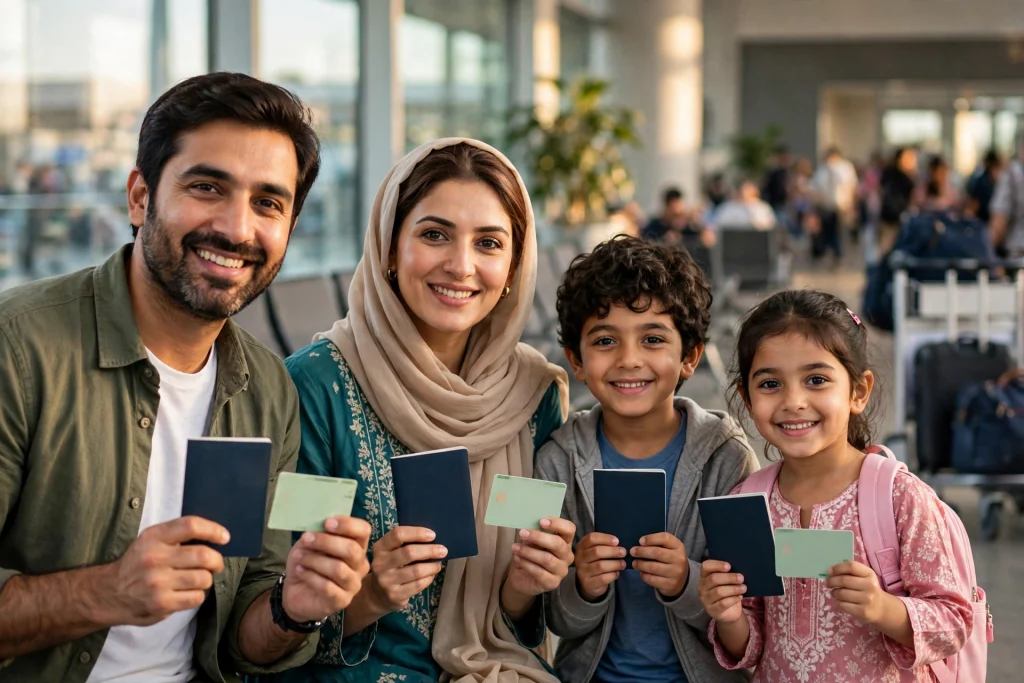
If you are a Pakistani living abroad, your NICOP is the one card you cannot afford to let expire quietly. It proves your identity and your link to Pakistan, and when it lapses, simple things like travel, banking and official paperwork can suddenly become difficult. The good news is that renewing it from abroad has become easier. NADRA has expanded its overseas services, and the NICOP itself is changing format, from a chip-based card to a new QR-code polycarbonate card that is rolling out in phases.
This guide explains the change in plain words, and gives you a clear order to follow if your card is expiring: try the Pak ID app first, look for a weekend mobile registration operation second, and visit a mission counter third. It is written for overseas Pakistanis in the United Kingdom, Saudi Arabia and Dubai, and for families in Pakistan who are helping a relative abroad with the renewal.
What is a NICOP, and why does expiry matter abroad?
NICOP stands for National Identity Card for Overseas Pakistanis. It is issued by NADRA to Pakistani citizens who live abroad. For many overseas Pakistanis, it is the main identity document they use when dealing with Pakistani authorities, and it is often asked for when they travel to Pakistan or handle property, banking and family matters back home.
That is why an expired or invalid card causes real stress. An overseas Pakistani who discovers the problem at the airport or at a government office is already late. The sensible approach is to check the expiry date on your card today, and start the renewal well before you plan to travel. The new overseas services described below are designed to make that possible without taking a day off work or flying to a distant city just to visit an office.
The big change: a QR-code NICOP replaces the chip card
The most important change is the card itself. NADRA’s new format is a QR-code polycarbonate NICOP. It was approved on 23 February 2026, and the National Identity Card and Pakistan Origin Card Rules, 2002 were amended on 24 February 2026 to support it. The new card is being rolled out in phases, so not every applicant will necessarily receive the new format at the same time. If you apply during the transition, the format you receive depends on the rollout stage at your location.
The new card replaces the older chip-based system. The chip system had two practical problems. First, it needed chip-reader infrastructure, which is costly to install and maintain. Second, it had interoperability problems, meaning the chip did not always work smoothly with every reader and system. The QR-code format removes both problems at a stroke.
On the new card, a QR code holds protected applicant information, including the family number. The information is read through the Pak ID app, so there is no need for a specialised card reader. That is a genuine improvement for everyday use: any authorised check can be done with a phone running the Pak ID app, instead of depending on special hardware being available at the right place and time.
There are two further benefits. The new card is made from polycarbonate, which offers better durability and security than the older card material. And because the card can be produced domestically, Pakistan should rely less on imported card material. That matters because imported material can cause delays when supplies run short, and domestic production gives NADRA more control over its own card supply.
Old chip card vs new QR-code card
| Feature | Old chip-based NICOP | New QR-code polycarbonate NICOP |
|---|---|---|
| How information is stored | Chip embedded in the card | QR code printed on the card |
| What reads it | Specialised chip reader | Pak ID app on a phone |
| Reader cost problem | Costly chip-reader infrastructure | No specialised reader needed |
| Compatibility problem | Interoperability problems with some readers | Read through one standard app |
| Card material | Older card material | Polycarbonate, more durable |
| Production | Reliant on imported card material | Domestic production reduces import reliance |
| Information carried | Applicant details on the chip | Protected applicant information including the family number |
The table makes the practical point clearly. The new card is simpler to verify, harder to damage and easier to produce. The QR code is not just a decoration. It is the new way the card is read, and the Pak ID app is the tool that reads it.
The renewal route: app first, mobile operation second, mission counter third
NADRA’s overseas expansion gives you three routes, and the order matters. Trying them in the right order saves you the most time and effort.
First, try the Pak ID app. The app lets users submit and process applications remotely, so a routine renewal needs no office visit at all. If your case is straightforward, this is the fastest route, and you can do it from home at any hour.
Second, if you cannot complete the renewal through the app, look for a weekend Mobile Registration Operation. NADRA runs weekend mobile operations in the United Kingdom, Saudi Arabia and Dubai, specifically for people who cannot visit offices during working hours. If you work weekdays, or if you live far from a mission, a weekend operation may be your best option.
Third, visit a mission counter. Counters at Pakistani missions handle online application submissions and routine ID services. This is the right route if you need in-person help, if your case is not routine, or if the app route has not worked for you.
This order, app first, mobile operation second, mission counter third, is the simplest way to think about it. Start with the option that costs you the least time, and only travel to an office when you actually need to.
Step by step: renewing through the Pak ID app
The Pak ID app is the centre of the new overseas system, so it is worth understanding what it does. It is NADRA’s own application, and it now does far more than it used to. You can submit an application through it, process it remotely, and use it to read the QR code on the new card. Eligible holders can also access their digital credentials through it, as explained below.
Before you start, keep your current card, your passport details and a recent photograph ready, and make sure your phone number and email address are ones you can actually access. Renewal applications commonly stall because a verification code goes to an old number or an inbox the applicant no longer uses. Updating your contact details first is a small step that prevents a large delay.
Then open the Pak ID app and follow the renewal flow for your card type. Read each screen before you confirm it, and check that the personal details shown match your existing record. If anything looks wrong, do not rush past it. A small error in a name spelling, a date of birth or a family detail can cause a longer delay later than the few minutes it takes to correct it now.
One caution applies to every online application. Use only NADRA’s official Pak ID app and official channels. Do not hand your card details, photographs or payment information to an unofficial agent or a social media account that promises a faster renewal. The app route exists precisely so that you do not need a middleman, and paying one adds risk without adding speed.
Weekend mobile operations in the UK, Saudi Arabia and Dubai
Not everyone can visit an office during working hours, and not everyone lives near a Pakistani mission. That is the gap the weekend Mobile Registration Operations are meant to fill. These are mobile operations run at weekends in the United Kingdom, Saudi Arabia and Dubai, for people who cannot visit offices in working hours.
If you work six days a week, if your job does not allow weekday leave, or if the nearest mission is a long journey away, a weekend operation can be the difference between renewing on time and letting the card lapse. Because these operations are mobile and scheduled, the practical step is to watch for announcements from your local Pakistani mission or community channels about when the next operation is planned near you, and to keep your documents ready so you can attend when one is announced.
Families in Pakistan can help here too. If your relative abroad works long hours and misses announcements, a family member can keep an eye out for the next weekend operation dates and pass the information on. That small help can be the reason a renewal happens before a planned trip rather than after a problem.
What the mission counters do: 10 centres and 25 counters, kept separate
Two different figures are often confused, so keep them separate. Ten registration centres at Pakistani missions now use NADRA’s Pak ID software application, and that change raises the daily NICOP renewal capacity at those centres. In other words, those ten centres can now process more renewals each day than before, because they are running NADRA’s own software.
Separately, 25 counters at Pakistani missions handle online application submissions and routine ID services. These are the counters where you can go for help submitting an online application, or for routine identity services that need an in-person visit.
The two figures describe different things, and they should not be added together. Ten is the number of registration centres now using the Pak ID software application. Twenty-five is the number of counters handling online submissions and routine services. Together, they show the same picture from two angles: NADRA is increasing both the daily processing capacity at its overseas centres and the number of places where an applicant can get help in person.
If your renewal is not routine, or if the app route has not worked, a mission counter is the right next step. Take your current card, your passport and any supporting documents, and allow enough time for the visit. If your case involves a change of personal details rather than a simple renewal, say so at the counter, because a change of details may follow a different process from a straightforward renewal.
Dematerialised cards: your digital NICOP in the Pak ID app
Alongside the new physical card, NADRA has introduced dematerialised cards. These were introduced under a Statutory Regulatory Order dated 9 September 2025. Eligible holders can access their digital credentials through the Pak ID app, and the digital credential carries the same legal validity as the physical card.
For an overseas Pakistani, that is a useful safety net. If your physical card is lost, damaged or delayed in delivery, your digital credential in the Pak ID app still proves your identity with the same legal standing. It also means you do not always need to carry the physical card to prove who you are, as long as your phone and the app are available.
Eligibility matters, though. Dematerialised cards are available to eligible holders, so not every applicant will necessarily qualify at the same stage. If you are unsure whether you are eligible, check in the Pak ID app or ask at a mission counter. Do not assume that a screenshot or a photo of your card is the same thing as a dematerialised credential. The digital credential is issued through the official app, and that official version is the one that carries legal validity.
What has not changed: your existing smart card still works
If you already hold a Smart CNIC, a Smart NICOP or a Smart POC, you do not need to panic about the new format. Existing smart cards still work during the transition, subject to the rules and to card material availability. The new QR-code card is being rolled out in phases, not switched on overnight for everyone.
That means two things in practice. First, do not throw away or stop using your current card just because a new format exists. It remains valid while the transition is under way. Second, do not delay your renewal because you are waiting for the new format. Renew when your card is due, and the format you receive will be the one in use at your location at that time.
The transition also explains why experiences may differ between applicants. One person renewing in one city may receive the new QR-code card, while another renewing elsewhere may still receive the older format, depending on how far the phased rollout has reached. That difference is normal during a phased change, and it is not a sign that either card is invalid.
What the government has not said yet
Honest reporting means stating the gaps as well as the progress. The details in this article come from a government written reply to the National Assembly, given by Interior Minister Senator Mohsin Raza Naqvi and reported on 28 October 2026. That reply answers some questions and leaves others open.
The minister declined to estimate how many overseas Pakistanis face travel issues because of expired or invalid NICOPs, saying the question did not pertain to NADRA. No number is given here, because no official number has been given. Any article or social media post that quotes a figure for how many people are affected is guessing, and you should treat it as a guess.
No communication strategy was shared in the reply either, and the government has not detailed how many people the travel rule changes could affect. The reply also does not describe the travel rule changes themselves in detail. This article therefore does not describe any specific new travel rules, because the official reply does not give them. If you read a claim about a specific new travel rule, check whether it comes from an official NADRA or government announcement before you act on it.
These gaps matter for planning. They mean that overseas Pakistanis should not wait for a publicity campaign to tell them to renew. Check your own card’s expiry date, and act on it, rather than assuming an announcement will reach you in time.
Common problems and how to avoid them
The most common problem is the simplest: the card expires unnoticed. Put a reminder in your phone a few months before the expiry date, and renew early. A renewal started early is a routine task. A renewal started after expiry, close to a travel date, is a crisis.
The second common problem is relying on an unofficial helper. Renewal through the Pak ID app is designed to be done by the applicant. If someone asks for your card photographs, your personal details or a payment outside the official app, stop and verify. Your identity documents are valuable, and handing them to a stranger creates a risk that no faster service can justify.
The third problem is assuming every route is available everywhere. The rollout is phased, weekend operations are scheduled events, and mission services vary by location. Before you travel to a mission or a mobile operation, confirm the schedule and the services offered at that location. A short check in advance saves a wasted journey.
The fourth problem is a mismatch in personal details. If your name, family details or other record information has changed, or if the record shown in the app does not match your documents, raise it early in the process rather than at the end. Corrections take time, and starting them early keeps your renewal on track.
How families in Pakistan can help a relative abroad
Many overseas Pakistanis rely on family in Pakistan to help with paperwork, and this renewal is no exception. A family member can remind the overseas relative of the expiry date, help gather supporting documents, and keep track of weekend operation announcements and mission service updates.
What a family member should not do is share the relative’s identity documents carelessly, or submit an application using someone else’s personal details without the applicant’s knowledge. The applicant’s own Pak ID account and verification are part of the process, and the safest help is practical help: reminders, documents, information and encouragement, while the applicant completes the application through the official route.
For parents and spouses in Pakistan, the most valuable help is often the simplest: a phone call a few months before expiry, asking whether the renewal has been started. That one call can prevent the far more stressful call that comes when a trip is blocked by an expired card.
The bottom line for overseas Pakistanis
The overseas NICOP system is moving in a helpful direction. The new QR-code polycarbonate card is easier to read, more durable and less dependent on costly readers and imported material. Ten mission registration centres now run NADRA’s Pak ID software, raising daily renewal capacity. Twenty-five mission counters handle online submissions and routine services. Weekend mobile operations in the United Kingdom, Saudi Arabia and Dubai serve people who cannot visit offices in working hours. And dematerialised digital credentials give eligible holders a legally valid card inside the Pak ID app itself.
None of that removes the one responsibility that stays with the cardholder: watch your expiry date and renew in time. The best route is the Pak ID app first, a weekend mobile operation second, and a mission counter third. Start early, use only official channels, and keep your contact details up to date in the app. Do that, and the new system should make your next renewal the easiest one you have done.
For readers who want to follow the original reporting behind this guide, TechJuice reported the government’s National Assembly reply and the overseas measures on 28 October 2026, and its article is the primary source for the dates, figures and rollout details used above.
FAQs
Can I renew my NICOP from abroad without visiting a Pakistani mission?
Yes, in many routine cases. The Pak ID app lets users submit and process applications remotely, so a routine renewal needs no office visit. If your case is not routine, or the app route does not work for you, a weekend mobile operation or a mission counter is the next step.
What is the new QR-code NICOP, and is my old chip card still valid?
The new card is a QR-code polycarbonate NICOP, approved on 23 February 2026, with the relevant rules amended on 24 February 2026. Its QR code holds protected applicant information, including the family number, and is read through the Pak ID app with no specialised card reader. Your existing Smart CNIC, Smart NICOP or Smart POC still works during the phased transition, subject to the rules and card material availability.
Where do weekend Mobile Registration Operations run?
Weekend Mobile Registration Operations run in the United Kingdom, Saudi Arabia and Dubai, for people who cannot visit offices during working hours. Because they are scheduled mobile operations, check announcements from your local Pakistani mission for the next dates near you, and keep your documents ready.
What is a dematerialised NICOP, and does it have the same legal validity as the physical card?
A dematerialised card is a digital credential accessed through the Pak ID app, introduced under an SRO dated 9 September 2025. For eligible holders, it carries the same legal validity as the physical card. Eligibility varies, so check in the Pak ID app or at a mission counter if you are unsure whether you qualify.