
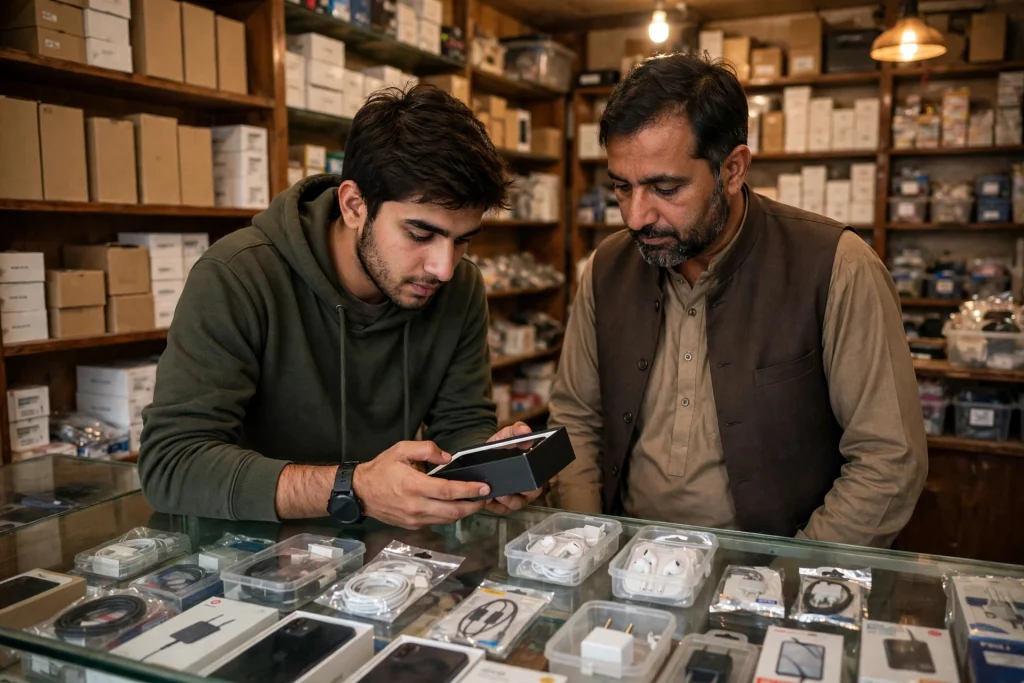
A good smartphone in Pakistan now costs more than many families earn in a whole month. For a student, a shopkeeper, a rider or a daily-wage worker, paying the full price in one go is often impossible. That is why buying a phone on installments sounds like the perfect answer: pay a little every month and use the phone from day one.
But there is a problem. The rules for smartphone installments in Pakistan are not clear yet. On 5 November 2026, Bloom Pakistan reported that the country’s four big telecom operators have asked the Pakistan Telecommunication Authority (PTA) to make clear rules for smartphone financing. The operators want a proper framework, and part of their proposal is a warning that should make every buyer stop and read carefully: SIM blocking as a last resort for customers who keep missing their installment payments.
Before you sign any installment deal, you need to know what has actually been decided and what has not. Right now, the framework is only a proposal. It is not law, it is not final, and no one can tell you today that your SIM “will be blocked” if you miss a payment. This guide explains what the operators asked for, why the rules are still pending, and the safe steps you can take if you buy a phone on installments today.
Why So Many Pakistanis Cannot Buy a Phone Outright
The core problem is price. Smartphone prices in Pakistan have climbed sharply, and for a large part of the population even an entry-level phone is a big purchase. The numbers behind this are stark. According to the Pakistan Bureau of Statistics Household Integrated Economic Survey 2024–25, only 50 percent of people aged 10 and above own a mobile phone. The gap between men and women is wide: about 70 percent of men own a phone, compared with only about 30 percent of women.
The picture is similar when it comes to actually using the internet on a phone. A GSMA report from August 2025 found that mobile broadband networks cover around 80 percent of Pakistan’s population, yet only 30 percent of people used mobile internet in 2024. Coverage is not the same as ownership. Millions of people live within range of a mobile network but do not have a phone in their hand, and price is the biggest reason.
| What the numbers say | Figure |
|---|---|
| People aged 10+ who own a mobile phone | 50% |
| Men who own a mobile phone | About 70% |
| Women who own a mobile phone | About 30% |
| Population covered by mobile broadband | About 80% |
| People who used mobile internet in 2024 | 30% |
This is why installment plans matter so much. If a phone can be paid for in monthly parts instead of one large payment, far more people could own one. But installment plans only work when both sides trust the system: the buyer must trust that the terms are fair, and the seller must trust that the buyer will keep paying. In Pakistan, that trust is still being built, and that is exactly what the operators’ letter to PTA is about.
What the Four Operators Asked PTA to Do
Pakistan’s four major telecom operators — Jazz, PTCL/Ufone, Telenor and Zong — jointly wrote to PTA on 7 May 2026. In that letter, they asked the regulator to introduce clear rules for smartphone financing and sought government support for a proper regulatory framework.
Why did the operators write together? Because they all face the same problem. They want more Pakistanis to own smartphones — more phone owners means more customers for mobile data and digital services — but they cannot expand financing on their own without rules that protect both the buyer and the seller. Without a framework, financing providers do not know what they are allowed to do when a customer stops paying, and customers do not know what rights they have.
The operators’ request covers the whole idea of smartphone financing: who can offer installment plans, what the terms should look like, and how payments can be recovered if a customer repeatedly fails to pay. It is a request for rules, not a set of rules itself. That distinction matters, and it is the most important thing to understand about this story.
The SIM-Blocking Proposal: Read It Carefully
The part of the proposal that has drawn the most attention is SIM blocking. The operators have proposed SIM blocking as a last resort for customers who repeatedly fail to pay their installments. Read those words again: last resort, repeated failure, and subject to customer consent and consumer protection safeguards.
That means three things. First, SIM blocking is proposed only as a final recovery measure — the last step after other ways of recovering the payment have failed, not the first step. Second, it would apply to customers who repeatedly miss payments, not to someone who is a few days late once. Third, it would be subject to the customer’s consent and to consumer protection safeguards, which means the customer would have to agree to the condition and there would have to be rules protecting them from unfair treatment.
No one should tell you today that your SIM “will be blocked” if you miss an installment. That is not the rule. There is no final rule yet. Anyone who uses the threat of SIM blocking to pressure you into paying, or to sell you a phone, is getting ahead of the facts. If a seller warns you about SIM blocking, ask them to show you the rule in writing. As of 5 November 2026, no such final rule exists.
Why Nothing Is Final Yet
You may be wondering about the dates. The operators wrote to PTA on 7 May 2026, but the story was reported on 5 November 2026 — almost six months later. The reason for the gap is simple: the framework is still not finalised. The push was reported again in November because the issue is still pending, not because something new was decided.
Industry sources say financing providers remain uncertain about how they can recover payments from customers who repeatedly miss installments. That uncertainty is the heart of the delay. Until there are clear rules, companies are careful about offering installments to people without a formal credit record, and customers are left guessing about their rights.
So the honest position, as of 5 November 2026, is this: the operators asked for rules in May, PTA has not finalised a framework, and the proposal — including SIM blocking as a last resort — remains a proposal. If PTA responds to the May letter or finalises anything after 5 November, that will be a new development, and it will need to be reported on its own facts.
Why Phone Financing Is So Hard in Pakistan
Even with the best rules, financing a phone in Pakistan is difficult for a simple reason: most people have no formal credit history. Financing companies struggle to assess customers who do not have formal employment records or salary slips. A large number of informal-sector workers — shopkeepers, drivers, daily-wage workers, freelancers — earn real money but cannot show a payslip or a bank statement that a financing company can check in the usual way.
That leaves financing providers with a hard choice. If they lend to people they cannot assess, they risk losing money when payments stop. If they refuse, millions of people stay without a phone. This is the gap the proposed framework is meant to close: clear rules would let companies offer installments more widely while giving customers real protection.
The report also notes that reviewing duties and taxes on entry-level smartphones could help reduce device prices. Lower prices would make the whole problem smaller, because a cheaper phone is easier to finance and easier to pay off. But that, too, is a suggestion for the future, not a change that has happened.
Kistpay: The One Provider Named So Far
If you want to buy a phone on installments today, the name you will hear most often is Kistpay. The report names Kistpay as a company that already offers smartphones on installments, including through partnerships with telecom operators. It is the only financing provider named in the source for this story, and this article does not invent others or their terms.
Even so, expanding financing to underserved customers remains hard because of repayment risk. Kistpay and companies like it face the same problem as everyone else in this market: how to offer installments to people without formal credit records and still get paid. That is why the operators are pushing for a framework — the current system works for some customers, but it does not reach everyone.
If a seller tells you about an installment plan from a company you have never heard of, do not take the name alone as proof that the plan is safe. Ask for the company’s full name, the written agreement, and the total cost. A real plan has all of these in writing.
SBP’s Draft Open Banking Rules Could Help
There is one more development that could change this picture. The State Bank of Pakistan (SBP) released draft Open Banking Regulations for public consultation on 30 October 2026. These are draft rules, out for public comment — they are not final law, and they should never be described as law.
If the draft becomes final, it could let financing providers assess applicants through verified financial transaction records, with the customer’s consent, instead of relying only on traditional credit histories. That matters because it could open the door for freelancers, small business owners and informal workers — people who earn money through mobile wallets and bank transfers but have no salary slip — to prove they can pay.
In simple words: today a financing company asks, “Show me your salary slip.” Under open banking, it could ask, “May I check your verified transaction record?” That is a different question, and for millions of Pakistanis it is a fairer one. But it is still only a draft. Until SBP finalises the regulations after consultation, it is a possibility, not a promise.
What Is Decided and What Is Still Pending
| Question | Position as of 5 Nov 2026 |
|---|---|
| Have PTA installment rules been approved? | No — the framework is a proposal, not finalised |
| Was a letter sent to PTA? | Yes — the four operators wrote jointly on 7 May 2026 |
| Is SIM blocking a rule today? | No — it is proposed only as a last resort, with consent and safeguards |
| Can you buy a phone on installments today? | Yes — Kistpay already offers installments through operator partnerships |
| Are SBP Open Banking rules final? | No — draft only, out for public consultation since 30 Oct 2026 |
| Have duties and taxes on entry-level phones been cut? | No — reviewing them is a suggestion, not a change |
Keep this table in mind whenever you read a new claim about installment phones. If someone says “PTA has approved” or “your SIM will be blocked”, check it against this table. As of 5 November 2026, neither claim is true.
How to Buy a Phone on Installments Safely Right Now
The rules are not final, but phones are still being sold on installments today. Here are safe steps you can take with any plan you are offered. None of these steps require a new law — they are basic checks that protect you under any agreement.
First, check that the phone is PTA-approved before you pay anything. Ask the seller for the phone’s IMEI number and verify it through PTA’s own check — for example by sending the IMEI by SMS to 8484 — and only pay once the phone shows as approved. A phone that is not PTA-approved can be blocked from the network later, and that problem has nothing to do with installments.
Second, get the full agreement in writing before you sign or pay. Ask for the total cost of the phone under the plan, not just the monthly amount. Ask how many months you will pay, what the first payment covers, and what happens if you are late. If the seller cannot put these things in writing, do not sign.
Third, ask directly what happens if you miss a payment. A fair seller will explain the process in plain words: a reminder first, a grace period, and then the next steps. Be careful if the seller’s only answer is a threat, such as “your SIM will be blocked”. As explained above, that is not a final rule, and a seller who uses it as a threat is not giving you honest information.
Fourth, keep proof of every payment you make. Save receipts, screenshots of transfers, and any messages from the seller confirming a payment. If there is ever a dispute about whether you paid, your own records are your best protection.
Fifth, keep your CNIC and your SIM in your own control. Share copies only where they are genuinely required for the agreement, and never hand over your original CNIC or your active SIM to a seller as “security” for an installment plan. A proper agreement does not need you to surrender your identity card or your number.
Sixth, buy from a known shop or an operator outlet and take a proper receipt that shows the phone’s IMEI number, the model, the total price and the payment schedule. A receipt with the IMEI on it links your payments to your exact phone, and it makes any later complaint much easier to prove.
Red Flags to Watch For
Walk away, or at least stop and think, if you see any of these signs. A seller who asks for the full price upfront for a so-called installment plan is not offering installments at all. A seller who refuses to give you a written agreement is asking you to trust them with no protection. A seller who pressures you to sign quickly, without time to read, does not want you to understand what you are signing.
Be careful too if the total cost is vague. If the seller will only tell you the monthly amount and will not tell you the total you will pay over the whole plan, you cannot know whether the deal is fair. And be careful of promises that sound too good, such as “guaranteed approval” or “no documents needed”. No financing company can guarantee approval without checking anything, and no seller can promise you protection that the law has not yet created.
What This Story Is Not
Two other stories on this site can look similar, so here is the difference. This article is about buying a phone on installments and the proposed PTA framework. It is not about the charges for sending money to a CNIC through JazzCash, Easypaisa or UPaisa — that is a different topic, covered in our CNIC transfer charges guide. And it is not about a Jazz SIM being blocked while you are abroad — that is about inactive SIMs and travel, not about installment payments. If you came here looking for one of those topics, use the links below to reach the right guide.
The key point to carry away is simple. Smartphone installments could put a phone in the hands of millions more Pakistanis, and the operators have asked PTA to write the rules. But the rules are not final yet, SIM blocking is only a proposed last resort with consent and safeguards, and no seller can use it as a threat today. Until the framework is finalised, your best protection is your own care: check the phone, read the agreement, ask the hard questions, and keep every receipt.
Bloom Pakistan reported on 5 November 2026 that Pakistan’s four major telecom operators — Jazz, PTCL/Ufone, Telenor and Zong — jointly asked PTA in a letter dated 7 May 2026 to introduce clear rules for smartphone financing, with SIM blocking proposed only as a last resort subject to customer consent and consumer protection safeguards, and that the framework remains not finalised. The same report notes the PBS survey finding that only 50 percent of people aged 10 and above own a mobile phone, and that SBP released draft Open Banking Regulations for public consultation on 30 October 2026. You can read the full report on the Bloom Pakistan website.
FAQs
Has PTA approved rules for smartphone installment plans?
No. As of 5 November 2026, the framework is still a proposal and has not been finalised. The four operators — Jazz, PTCL/Ufone, Telenor and Zong — wrote a joint letter to PTA on 7 May 2026 asking for clear rules and government support, but no final framework has been announced. Any claim that PTA “has approved” installment rules is not correct on the facts available today.
Can my SIM be blocked if I miss an installment payment?
Not under any final rule. SIM blocking has only been proposed as a last resort for customers who repeatedly fail to pay, and only subject to customer consent and consumer protection safeguards. It is not an automatic penalty, it is not for a single late payment, and it is not in force today. If a seller threatens SIM blocking, ask them to show the rule in writing — as of 5 November 2026, there is no final rule to show.
Can I buy a phone on installments in Pakistan today?
Yes. Kistpay already offers smartphones on installments, including through partnerships with telecom operators. Before you sign any plan, check that the phone is PTA-approved, get the full agreement and the total cost in writing, ask what happens if you miss a payment, and keep proof of every payment you make.
What should I check before signing an installment agreement?
Check four things. First, the phone’s IMEI and PTA approval status. Second, the total cost of the plan in writing, not just the monthly amount. Third, the written terms for late or missed payments. Fourth, that you receive a proper receipt showing the phone’s IMEI, the model, the total price and the payment schedule. Never hand over your original CNIC or your active SIM as security for a plan.