
Walk into three different mobile franchises in Pakistan and ask for an eSIM, and you may hear three different prices. One operator’s website says Rs 1,500, another says Rs 2,000, and the shopkeeper may quote something else again. So what should an eSIM actually cost — and what do you do if you are charged more?
We checked the operators’ own published prices (as listed on 19 October 2026). In this guide you will find what Jazz, Zong and Ufone actually charge, what PTA’s reported Rs 1,500 cap means for you, the step-by-step process to get an eSIM, and one easily missed step — sending your IMEIs to 8484 — that can leave your eSIM showing “no service” if you skip it.
What Is an eSIM? (The Short Version)
An eSIM is a digital SIM built into your phone. Instead of inserting a plastic SIM card, you scan a QR code and your mobile number is downloaded onto the phone. Everything else — your number, your package, your balance — works exactly like a normal SIM. The advantage is convenience: no card to cut or lose, and many phones can keep a physical SIM and an eSIM active at the same time.
What Each Operator Charges
Here are the eSIM charges the operators themselves publish, checked on 19 October 2026:
| Operator | Published eSIM charge | Where you get it | Notes |
|---|---|---|---|
| Zong | Rs 1,500 | Customer service centre / franchise | Matches the reported PTA cap |
| Jazz | Rs 2,000 | Experience centre, franchise or eligible retailer | Excludes standard number charges; sits above the reported cap |
| Ufone | Rs 1,500 and Rs 2,000 both printed | Customer service centre / franchise | Ufone’s price section says Rs 1,500 (new customer or physical-SIM conversion), while its FAQ/terms mention Rs 2,000 “for a new sale” |
| Telenor | Not confirmed | — | We could not verify Telenor’s eSIM fee from its own pages, so we are not guessing a figure |
Read the table carefully: only Zong’s published price matches the reported cap outright. Jazz’s published Rs 2,000 is above it, and Ufone prints both figures in different places — which is exactly why customers get confused at the counter.
PTA’s Reported Rs 1,500 Cap — What It Means
PTA is reported to have capped eSIM charges at Rs 1,500, in force since mid-August 2026, along with ten free eSIM transfers between handsets — meaning moving your eSIM to a new phone should not cost you again and again.
Two honest points about this:
- We describe this as a reported cap. The reporting is consistent, but the figures above show that as of 19 October 2026, at least one operator’s own page still listed a higher charge. Rules on paper and prices at the counter are not always the same thing yet.
- Practically, this gives you a fair question to ask. If you are quoted more than Rs 1,500, ask about it before biometric verification, keep your receipt, and if the charge still looks wrong, complain to PTA. Operator helplines: Jazz 111, Zong 310, Ufone 333.
How to Get an eSIM: Step by Step
The process has the same shape on Jazz, Zong and Ufone:
- Check your phone supports eSIM (see the compatibility list below).
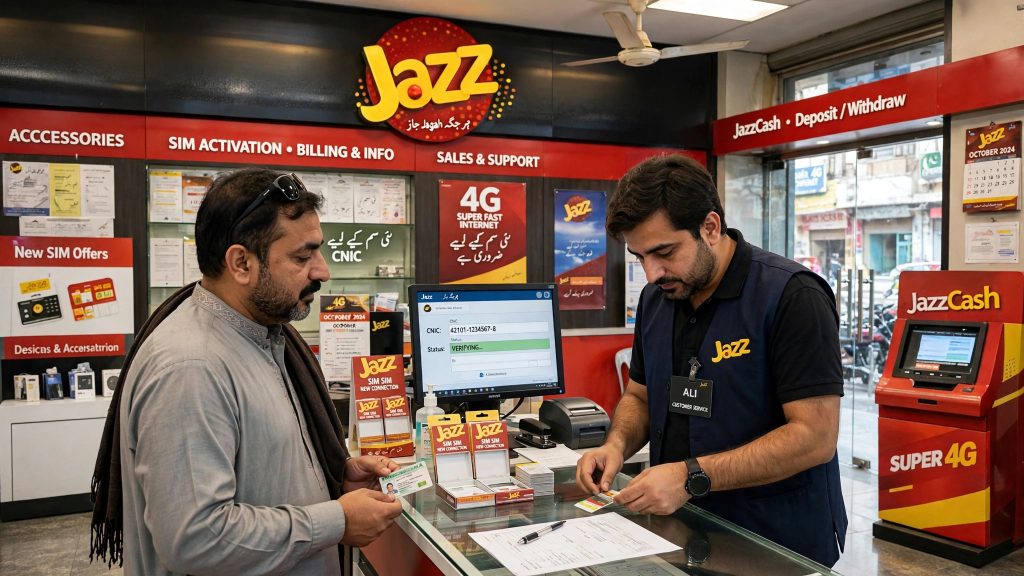
- Visit the operator’s customer service centre, franchise or eligible retailer with your CNIC. eSIM conversion is done in person.
- Complete biometric verification, just like buying a normal SIM.
- Pay the eSIM charge — check it against the table above first.
- You will receive a QR-code voucher. Keep it safe; treat it like the SIM itself.
- Connect your phone to Wi-Fi or mobile internet, open the SIM/eSIM settings on your phone, and scan the QR code.
- Your number activates on the eSIM — Jazz says activation takes about 5 minutes — and your physical SIM for that number deactivates. Your package, tariff and balance carry over; you do not lose your existing bundle.
⚠️ The Step Everyone Misses: Send Both IMEIs to 8484
This is the most important practical tip in this guide, and it applies to Jazz and Zong eSIM users.
Most eSIM phones have two IMEIs — one for the physical SIM slot and one for the eSIM. If only the first IMEI is registered in PTA’s DIRBS system, the eSIM slot can show no service, even though you did everything else correctly.
To avoid this, send both IMEIs of your phone to 8484, and email screenshots to [email protected], so the second (eSIM) IMEI is whitelisted in DIRBS. Do this before you panic, before you pay anyone to “fix” it, and before you blame the operator — in many cases this one step is the whole problem.
Which Phones Support eSIM?
Broadly, eSIM works on:
- iPhone XR and later
- Google Pixel 3 and later
- Many Samsung Galaxy S, Z and A series models
- Zong’s published list also covers many Infinix, TECNO, Xiaomi, OPPO, vivo and realme models — worth checking if you use a budget phone, because eSIM is no longer only a flagship feature.
Two warnings: carrier-locked handsets will not work with Ufone eSIM (and locked phones are a problem generally), and if Ufone asks for a QR PIN during setup, it is 0000.
Honest Caveats
- Prices move. The charges in this article are the operators’ published figures checked on 19 October 2026. An individual franchise may quote differently — which is why you should always ask the price before biometric verification and keep the receipt.
- Telenor’s fee is unconfirmed. We could not verify it from Telenor’s own published pages, so we have left it blank rather than print a guess. Ask Telenor directly or check at a franchise before you go.
- The Rs 1,500 cap is reported, not something we could re-confirm from PTA’s own notification at the time of checking. The safe approach: know the reported figure, compare it with what you are quoted, and use the complaint route if the difference is charged without explanation.
For most users with a compatible phone, eSIM is a five-minute job — as long as you know the right price before you walk in, and you remember the 8484 step afterwards.
FAQs
Q: What is the eSIM price in Pakistan?
It depends on the operator. Based on the operators’ own published prices checked on 19 October 2026, Zong charges Rs 1,500 and Jazz charges Rs 2,000 (excluding standard number charges). Ufone prints both Rs 1,500 and Rs 2,000 in different sections of its own material. PTA’s cap is reported to be Rs 1,500. Telenor’s fee could not be verified.
Q: What should I do if a shop charges me more than Rs 1,500 for an eSIM?
Ask about the charge before biometric verification, not after, and keep your receipt. PTA’s eSIM cap is reported at Rs 1,500 with ten free transfers between handsets. If you are still charged more without a clear reason, you can complain to PTA, or call your operator’s helpline — Jazz 111, Zong 310, Ufone 333.
Q: My eSIM shows “no service”. What went wrong?
The most common cause is the second IMEI. Phones have separate IMEIs for the physical slot and the eSIM, and if the eSIM IMEI is not whitelisted in DIRBS, that slot gets no service. Send both IMEIs to 8484 and email screenshots to [email protected] — for Jazz and Zong users, this step fixes the problem in many cases.
Q: Will I lose my package or balance when I convert to eSIM?
No. Converting your existing number to an eSIM does not change your package, tariff or balance — they carry over. Your physical SIM for that number deactivates once the eSIM activates, and Jazz puts the activation time at about five minutes.
Sources
- https://pakera.pk/esim-price-jazz-zong-ufone-pta-cap-rs-1500-pakistan/