
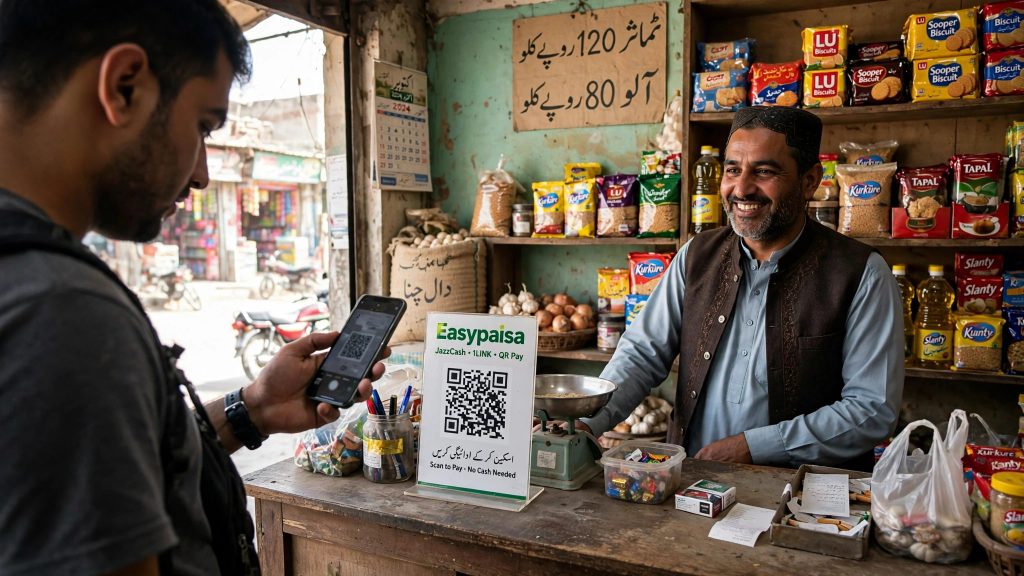
That QR code sticker you now see at every kiryana store, salon and chai dhaba is not there by accident. JazzCash has announced that its interoperable Raast QR merchant network has crossed 1.9 million merchants — up from under 1 million at the start of 2026 — and the company is targeting 2 million merchants by December 2026.
JazzCash CEO Murtaza Ali shared the figures at the IAMTN Annual Summit on 13 October 2026. This article explains what Raast QR actually is, why the number matters for both shoppers and small shopkeepers, and how you can pay with it — from any banking app, not just JazzCash.
First: What Is Raast QR?
Raast is Pakistan’s instant payment system, run under the State Bank of Pakistan (SBP). A Raast QR code is a printed square code that a shop sticks near its counter. When you want to pay, you scan it with your phone, type the amount, and the money moves instantly from your account to the shop’s account.
Two things make Raast QR different from the old way of digital payments:
- No machine needed. A shop does not need a costly POS card machine. A printed QR sticker is enough — which is why tiny shops, salons and even home businesses can accept digital payments.
- It is interoperable. One Raast QR at a shop can be paid from any bank app or mobile wallet — JazzCash, Easypaisa, or your regular bank’s app. You do not need the same app the shop uses.
The Numbers Behind the Milestone
These are the figures JazzCash and the SBP have reported:
| Figure | Number |
|---|---|
| JazzCash Raast QR merchants | 1.9 million (target: 2 million by Dec 2026) |
| JazzCash QR network volume | ~PKR 150 billion per month |
| Same network a year earlier | ~PKR 20 billion per month |
| All QR merchants in Pakistan (SBP) | 3.8 million in FY2025-26 |
| QR transactions nationally (SBP) | 297 million, worth Rs 1.6 trillion |
| Total Raast transactions | 742 million in Q3 FY26 (up from 371.2 million a year earlier) |
| JazzCash customers | 60 million+ |
Read the second and third rows together: the money moving through JazzCash’s QR network each month has grown roughly seven times in a year. Cash is quietly losing ground at the checkout counter.
The Government Push: Cashless Pakistan
This growth is being pushed from the top. Under the Prime Minister’s Cashless Pakistan Initiative, the government has allocated Rs 3.5 billion to encourage QR payments. Part of that money is a subsidy of 0.5% of each eligible transaction, capped at Rs 100, split between the merchant’s institution and the customer’s institution.
The direction is clear: with a national push running to the end of 2026 — JazzCash’s own 2-million-merchant target is set for December 2026 — expect QR stickers to appear in even more places, from fruit carts to tuition centres.
What This Means for Shoppers
- Pay from the app you already have. Because Raast QR is interoperable, you can pay a JazzCash-network shop using your own bank’s app or any wallet. No new account is forced on you.
- No cash, no change problem. You pay the exact amount — no “khullay nahi hain” at the counter.
- A record of every payment. Your app keeps the history, which helps with budgeting and with proving a payment if a dispute ever comes up.
What This Means for Small Shops
For a shopkeeper, accepting Raast QR is about more than convenience:
- Near-zero setup cost. A printed sticker replaces a card machine.
- Money lands in an account, not a drawer. That means less risk of theft and fake notes.
- A transaction record builds a financial history. A shop that can show regular digital income is in a stronger position when it later applies for a loan or financing. This matters in a market where JazzCash alone says it issues an average of 200,000+ digital loans daily — records are what make small borrowers visible to lenders.
How to Pay With Raast QR: Step by Step
App menus differ slightly, but the general steps are the same in almost every Pakistani banking app and wallet:
- Open your bank app or mobile wallet (any of them — it does not have to be JazzCash).
- Look for Scan QR, QR Payment or Raast QR on the home screen or payments menu.
- Point your camera at the shop’s printed QR code.
- Check that the shop’s name shown on your screen matches the shop you are in.
- Enter the amount, confirm, and approve with your PIN or fingerprint.
- Show the success screen to the shopkeeper. The payment is instant.
One safety habit: always confirm the merchant name on your screen before paying. A swapped sticker is a known trick — if the name looks wrong, do not pay.
Spotting a Tampered QR Sticker
That one habit deserves a fuller explanation, because the sticker’s weakness is also its strength: it is just printed paper, and printed paper can be covered up. The known fraud is simple — someone pastes their own QR sticker over a shop’s real one, and customers’ payments quietly land in the wrong account until the shopkeeper notices a day of “missing” sales.
Protect yourself with three checks that take seconds:
- Read the merchant name on your confirmation screen — not the name printed near the sticker. The app shows where the money is actually going. If it shows a person’s name you do not recognise instead of the shop’s, stop.
- Look at the sticker itself. A code pasted over another code — slightly raised edges, a second square underneath, fresh glue on an old board — is a warning sign worth mentioning to the shopkeeper, who is the fraud’s other victim.
- Say the amount aloud and confirm receipt. For anything beyond a small purchase, watch the shopkeeper check their own app for the incoming payment before you walk away. Instant settlement means there is no “it will come later” — if it has not arrived, it has not been paid.
What the Milestone Looks Like at One Counter
Statistics like “1.9 million merchants” become clearer at the level of a single shop. A neighbourhood kiryana store’s day used to end with a drawer of mixed notes, a change shortage by evening, and no written record of what it actually earned. With a QR sticker beside the till, the same day ends differently: payments arrive in the shop’s account in exact amounts, the change problem disappears for every customer who scans, and the month’s digital takings quietly add up to something the shop never had before — proof of income.
That proof is the deeper story behind the merchant count. A shop that has only ever dealt in cash is invisible to the formal financial system; a shop with a year of QR receipts has a documented business. Multiply that change by hundreds of thousands of small shops and the 1.9 million figure stops being a payments statistic and starts being a change in how Pakistan’s smallest businesses exist on paper.
One Fair Concern
The rollout is not without critics. Traders’ bodies, including the All Karachi Tajir Ittehad, have publicly asked the government for clearer policy and better incentives for merchants. Their concern is worth noting: small traders want the rules and benefits explained plainly before cash disappears from their counters. A successful cashless push will need to answer them, not just count stickers.
Note: the figures in this article are company and SBP statements reported from the summit and official releases; they are presented as reported, not independently audited.
To check the prices, charts and original details as proof, you can visit TechX.
Also read: JazzCash Scraps Its Rs 100 Monthly Inactivity Fee · Daraz PayLater in Pakistan: The Real Cost · eSIM in Pakistan: What Jazz, Zong and Ufone Actually Charge
FAQs
Q: Can I pay a JazzCash Raast QR code from a different app, like my bank’s app or Easypaisa?
Yes. That is the main point of Raast QR — it is interoperable. A QR code on JazzCash’s merchant network can be paid from any bank app or mobile wallet that supports Raast QR. You do not need a JazzCash account to pay a shop that displays one.
Q: What exactly did JazzCash announce about Raast QR merchants?
Speaking at the IAMTN Annual Summit on 13 October 2026, JazzCash CEO Murtaza Ali said the company’s interoperable Raast QR merchant network has crossed 1.9 million merchants, up from under 1 million at the start of 2026, with a target of 2 million by December 2026. The network now processes close to PKR 150 billion per month.
Q: Does a shopkeeper need a card machine or a JazzCash shop account to accept Raast QR?
No card machine is needed — a printed QR sticker at the counter is enough, which is why very small shops and home businesses can accept payments. The shop registers as a merchant with a provider such as JazzCash, and customers then pay that one QR from any app.
Q: Is there a government incentive for QR payments in Pakistan?
Yes. Under the Prime Minister’s Cashless Pakistan Initiative, Rs 3.5 billion has been allocated, including a subsidy of 0.5% of each eligible transaction, capped at Rs 100, split between the merchant’s and the customer’s institutions. The aim is to encourage both sides to choose QR over cash.
Pingback: Daraz PayLater Real Cost: 16% a Month & 192% APR Explained
Pingback: Raast Beginner Guide Pakistan 2026: Free Instant Transfers