
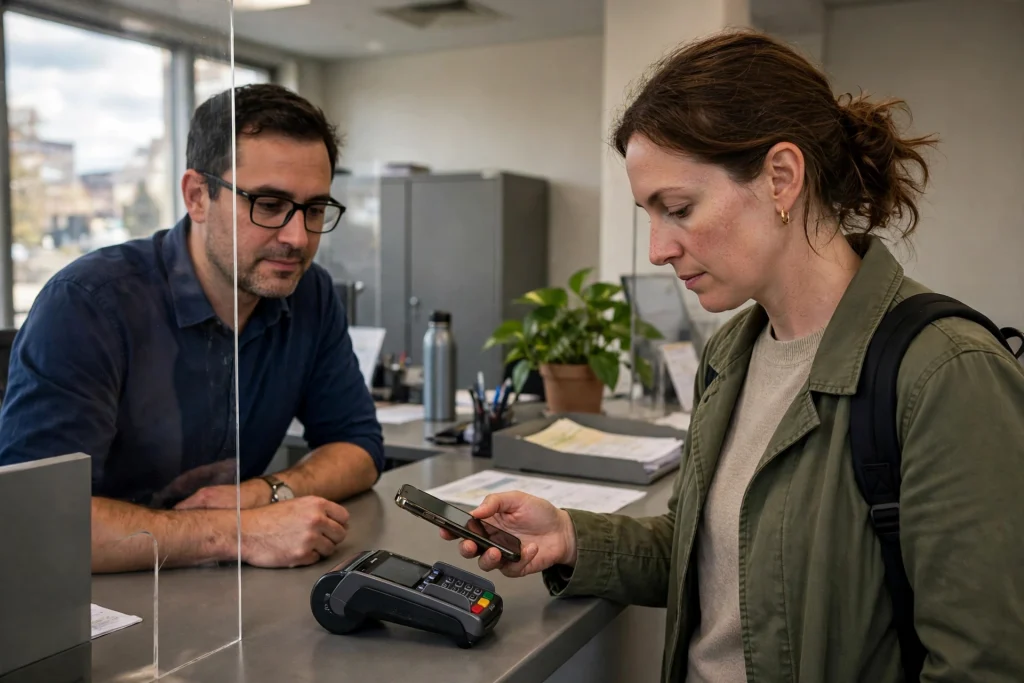
If you have visited a NADRA service centre in Pakistan in the past, you probably remember the routine well. You went to the centre, you waited for your turn, you gave your fingerprints and had your photograph taken, and then, at some point in the process, the fee had to be sorted out. For many people, that fee step meant extra running around, extra waiting, and extra confusion, especially if you had travelled a long distance to reach the centre. A change reviewed in October 2026 aims to make that part of the visit simpler. NADRA has now digitised 99 percent of payments at its service centres across the country, which means that in most cases you can now pay the fee digitally at the centre itself, instead of following a separate, older payment route.
This article explains what that change really means in plain language. It covers what has changed, what has not changed, what you still need to do in person, and what you should check before you leave home. It is written for ordinary visitors, not for officials or experts, so it focuses on the practical details that affect your visit: your time, your documents, your payment, and your trip to the centre.
What the October change actually is
On 13 October 2026, the Finance Division held a meeting in Islamabad to review the Prime Minister’s Cashless Pakistan initiative. The meeting was chaired by Minister of State for Railways and Finance Bilal Azhar Kayani. During that meeting, officials were briefed that NADRA has digitised 99 percent of payments at its service centres nationwide. In simple terms, this means that almost all fee payments connected with NADRA service centres can now be handled through digital payment channels, rather than through the older cash-and-paper methods that many visitors were used to.
The Cashless Pakistan initiative is a wider government effort to reduce dependence on cash and to increase the use of digital payments across public services and everyday business. NADRA is one of the most visited public service networks in the country. Millions of Pakistanis visit NADRA centres every year for national identity cards, family registration certificates, and other civil registration services. When a service network of that size moves its payments to digital channels, the effect on daily life is real, because it touches the routine of a very large number of people.
It is important to understand the exact meaning of the figure reported at the meeting. The figure is 99 percent, not 100 percent. That one percent matters, because it leaves room for exceptions, for centres or cases where the digital route may not be available, and for visitors who may still need guidance from staff at the centre. The change is therefore best understood as a major shift in how payments are made, not as a complete end to every older method in every single situation. If you arrive at a centre expecting everything to work in exactly the same way as it does at another centre, you may be surprised, so a little preparation before your visit is still worthwhile.
What 99 percent cashless means for a normal visitor
For most visitors, the practical meaning of this change is straightforward. The fee payment step is now part of the digitised flow at the centre. You do not need to treat payment as a separate journey that takes you away from the centre and back again. Instead, payment is handled as part of the same visit, through the digital options available at that centre. This saves time, reduces the number of queues you have to join, and lowers the chance of a small mistake, such as a wrong receipt or a missing paper slip, causing a delay in your application.
At the same time, the change does not turn a NADRA visit into something you can finish entirely from home. That point needs to be stated very clearly, because it is easy to misunderstand a headline about digitised payments. A digitised payment is only one step in the process. The identity verification steps that make a NADRA record trustworthy still require you to be present in person. Your fingerprints, your iris scan where required, and your photograph cannot be captured through a payment app. They must be recorded at the centre, by trained staff, using proper equipment, so that your record is accurate and secure.
The table below summarises the difference between the older routine and the newer digitised routine, so you can see at a glance what has changed and what has stayed the same.
| Step in your visit | Older routine | New digitised routine |
|---|---|---|
| Reaching the centre | Travel to the NADRA centre and join the queue | Same: travel to the centre and join the queue |
| Identity verification | Fingerprints, iris scan where required, and photograph taken in person | Same: these steps still happen in person at the centre |
| Fee payment | Often involved a separate trip or a separate paper-based step | In most cases, paid digitally at the centre as part of the same visit |
| Proof of payment | Paper receipt or challan slip to keep safe | Digital payment record, plus any receipt given at the centre |
| Follow-up | Return visits if a paper step was incomplete | Fewer separate payment trips, but in-person steps remain where required |
This table is a general guide, not a promise about every centre. Centres can differ, and staff at your local centre remain the best source of information about the exact payment options available there on the day of your visit.
What still needs a visit in person
Many readers will ask whether this change means they no longer need to visit a centre at all. The answer is no. If your service requires biometric registration, iris scanning, or photograph capture, you must still attend in person. These steps exist for a good reason. A national identity record must be linked to the real person it belongs to, and the only reliable way to do that is to capture your biometrics and your photograph under controlled conditions at the centre.
Think of the process in two parts. The first part proves who you are. The second part collects the fee for the service. The October change affects the second part, not the first part. It makes paying easier. It does not remove the need to prove who you are in person. If you are applying for a new card, renewing a card that requires fresh biometrics, or completing any service that involves a new photograph or fingerprint record, plan your visit in the same way you always have: set aside enough time, take your required documents, and expect to go through the verification counters.
Some services offered through the Pak ID online system are different, because certain renewals can be started online. That is a separate route with its own rules, and it is not the same thing as the cashless payment change at physical service centres. Do not mix the two up. If you are unsure which route applies to your case, ask at the centre or check the service description for your specific application before you travel. Choosing the wrong route can waste a trip, even when payment itself has become easier.
How payment at the centre works now
While the exact screens and counters can vary from one centre to another, the general flow for a visitor is now simpler than before. You arrive at the centre with your documents. You go through token issuance and verification. Your biometrics and photograph are captured where required. When you reach the fee step, you use one of the digital payment options accepted at that centre. You receive confirmation of the payment, and your application moves forward without you needing to leave the centre to complete a separate payment trip.
To make your visit smooth, follow these practical steps. First, confirm before you travel which digital payment methods your centre accepts. Second, make sure your payment method is ready before you leave home: your card is active, your mobile wallet has enough balance, or your bank app is working on your phone. Third, carry your original documents and any reference number or token related to your application. Fourth, keep the payment confirmation safe until your application is complete, even if it is a digital message on your phone. A screenshot or a saved message can help if staff later ask you to confirm that the fee was paid.
If your phone battery is low, or your mobile data is weak, plan for that as well. Charge your phone before the visit, and if possible, keep a backup payment option ready. These small preparations matter more now that payment is digital, because a dead phone or a failed app login can still cause a delay, even though the system itself is designed to be faster.
Passport centres: an end to the separate bank-branch trip
The October briefing also covered passport centres, and this part of the change will matter to many families. Passport centres have now been enabled to accept digital payments as well. In the older routine, an applicant often had to queue at an external bank branch to obtain a physical fee challan receipt before the passport process could move forward. That extra trip added time, cost, and stress, especially for people who lived far from a bank branch, or who were applying with children or elderly family members.
With digital payments enabled at passport centres, that separate bank-branch step is no longer the normal route in the digitised flow. You can complete the fee payment as part of your visit to the passport centre itself. This does not change the documents you need for a passport, the verification checks, or the processing time set by the passport authorities. It changes only the payment step, but for many applicants that single change removes one of the most frustrating parts of the whole experience.
If you are planning a passport visit, the same advice applies: confirm the accepted payment methods at your centre in advance, make sure your payment method is ready, and keep your payment confirmation safe. Families applying for several passports at once should also check whether each application is charged separately, and make sure enough balance is available for the full total before starting the process.
Fees: what has not changed
One of the most common misunderstandings about a move to digital payments is the idea that the price itself must have changed. That is not the case here. The October change is about the method of payment, not the amount of the fee. The statutory fees set for NADRA services still apply in full. You will pay the same official fee for your service; you will simply pay it through a digital channel at the centre, instead of through the older paper-based route.
This point is important for budgeting. Do not arrive at the centre expecting a lower fee because payment is now digital, and do not assume that a digital payment adds an extra charge either, unless staff at the centre clearly explain a specific charge that applies to your case. If anything about the fee looks different from what you expected, ask staff to explain the breakdown before you confirm the payment. A clear question at the counter is much easier to resolve than a complaint after the payment has gone through.
Keep in mind also that fees can differ by service type, by processing speed where urgent processing is offered, and by the specific document you are applying for. Always confirm the exact fee for your own application, rather than relying on the fee someone else paid for a different service. A family member’s card renewal fee is not necessarily the same as your new registration fee, even if both visits happen at the same centre.
Why payment methods can still vary by centre
Even though 99 percent of payments have been digitised nationwide, the experience at your local centre may not be identical to the experience at a centre in another city. Centres differ in size, in the equipment installed, in network connectivity, and in the stage of rollout they have reached. A large centre in a major city may accept a wider range of digital options than a smaller centre in a remote area. A temporary network problem can also affect which options work on a particular day.
For that reason, the safest approach is to confirm accepted methods before you travel. You can do this by calling the centre where a contact number is available, by asking someone who visited recently, or by checking with NADRA’s official helpline or service information for your area. Do not assume that every card or every mobile wallet will work at every centre. A method that worked for a friend in Lahore or Karachi may not be accepted at your centre, and the reverse is also true.
If the digital option you planned to use is not available when you arrive, stay calm and ask staff what alternatives are accepted at that centre. Staff deal with these questions every day, and they can usually guide you to the nearest workable option. Avoid paying through unofficial agents or middlemen who offer to handle the fee for you outside the centre. Official payment should happen through the centre’s own accepted channels, and anyone asking you to pay them personally for a NADRA fee should be treated with caution.
The bigger Cashless Pakistan picture
The NADRA change did not happen in isolation. It was reviewed as part of the wider Cashless Pakistan initiative, and the same October meeting discussed progress across the country. Officials noted that the number of merchants accepting digital payments grew fourfold in the last fiscal year. That is a large increase, and it suggests that digital payments are becoming a normal part of everyday business in Pakistan, not just a feature of government offices.
The meeting also noted around 75 percent digital payment acceptance across centralised and self-accounting federal entities. In plain language, this means that a large share of federal government bodies that handle their own accounts are now set up to accept digital payments. For citizens, the direction is clear: more public services are moving toward digital payment options, and the skills needed to pay digitally, such as using a bank app or a mobile wallet safely, are becoming more useful for everyday life.
The committee also decided to review and tighten the definitions used to count digital payment users. Terms such as active app users, active merchants, and unique digital payment users will be defined more carefully, so that future progress reports measure real usage rather than inflated numbers. The committee also asked the private sector for proposals on tax-policy reform to widen adoption further. These are policy steps that will shape how quickly digital payments spread, but they do not change what you need to do on your next NADRA visit. Your immediate task remains simple: confirm the payment method at your centre, keep your documents ready, and attend in person for biometrics and photographs where required.
Common mistakes to avoid on a cashless NADRA visit
First, do not skip the visit because you heard payments are now digital. As explained above, biometrics and photographs still require you to be present. Second, do not arrive with no payment method prepared, assuming cash alone will always be the fallback. While staff can advise you, a visit goes much more smoothly when your digital payment option is ready in advance. Third, do not share your bank app password, card PIN, or wallet OTP with anyone at or outside the centre. Genuine staff will never ask you for those details to process a fee. Fourth, do not throw away or delete your payment confirmation until your application is fully complete and you have received any receipt or tracking information the centre provides.
Fifth, be careful with agents outside the centre who claim they can speed up your application for an extra payment. NADRA has repeatedly warned the public about fake agents, and paying an unofficial person does not make your official application faster or safer. If someone pressures you, step inside the centre and speak to official staff instead. Your application, your biometrics, and your fee all belong inside the official process, not in a side deal outside the gate.
Finally, allow enough time for the visit. A digitised payment step can save you a separate trip, but it does not remove queues, verification checks, or the time needed for biometric capture. Arriving early, with documents and payment ready, remains the best way to finish your visit without stress.
What to do if something goes wrong with a digital payment
Digital systems are usually reliable, but occasional problems do happen. A payment may show as pending, a message may arrive late, or an app may close during the process. If this happens at the centre, do not leave immediately and do not attempt the same payment again without checking first, because a duplicate payment can create a new problem. Instead, inform the staff at the counter right away, show them any message or reference number you received, and ask them to check the status of your application before you take any further step.
If the amount was deducted from your account but the centre has no record of it, keep the bank or wallet message that shows the deduction, including the date, time, and transaction reference. That reference is the key detail your bank or wallet provider will need if you have to raise the matter with them later. In most cases, a pending transaction is resolved once the system updates, but having the reference ready makes any follow-up much faster.
If you have already left the centre when you notice a problem, contact the centre or the official helpline as soon as possible, and have your application number and payment reference ready. Do not share screenshots containing your full card number or account details on social media while asking for help. Share only the reference details that official support staff ask for, through official channels.
For readers who want to check the original reporting, Business Recorder covered the Finance Division meeting of 13 October 2026 and the briefing that NADRA has digitised 99 percent of payments at its service centres nationwide.
FAQs
1. Do I still need to visit a NADRA centre in person now that payments are 99 percent cashless?
Yes, you still need to visit in person for services that require biometric registration, iris scanning, or photograph capture. The cashless change affects how you pay the fee, not whether you need to attend for identity verification. Your fingerprints, iris scan where required, and photograph must still be recorded at the centre by official staff.
2. Does the cashless change mean my NADRA fee is now lower?
No, the fee itself has not changed. The October change is about the method of payment, not the amount. The official statutory fee for your service still applies in full, and you will pay it through a digital channel at the centre instead of through the older paper-based route. Always confirm the exact fee for your own service at the counter before you pay.
3. Will every card and mobile wallet work at every NADRA centre?
Not necessarily. Accepted payment methods can vary by centre, depending on the equipment installed, the stage of rollout, and network conditions on the day. Before you travel, confirm which digital payment methods your centre accepts, and keep a backup option ready if possible. Do not assume that a method accepted at one centre will be accepted at all centres.
4. Do I still need to visit a bank branch for a passport fee challan receipt?
No, in the digitised flow you no longer need a separate bank-branch trip for a physical fee challan receipt, because passport centres have been enabled to accept digital payments. You can now pay the passport fee digitally at the passport centre itself as part of your visit. The documents, verification checks, and processing rules for the passport itself remain unchanged.
Also read
Pak ID CNIC Renewal Online: Fees (Rs 400 or Rs 750?), Steps and Timelines Explained
NADRA Has No Agents: The Fake-Agent Warning Every Overseas Pakistani Must Read