
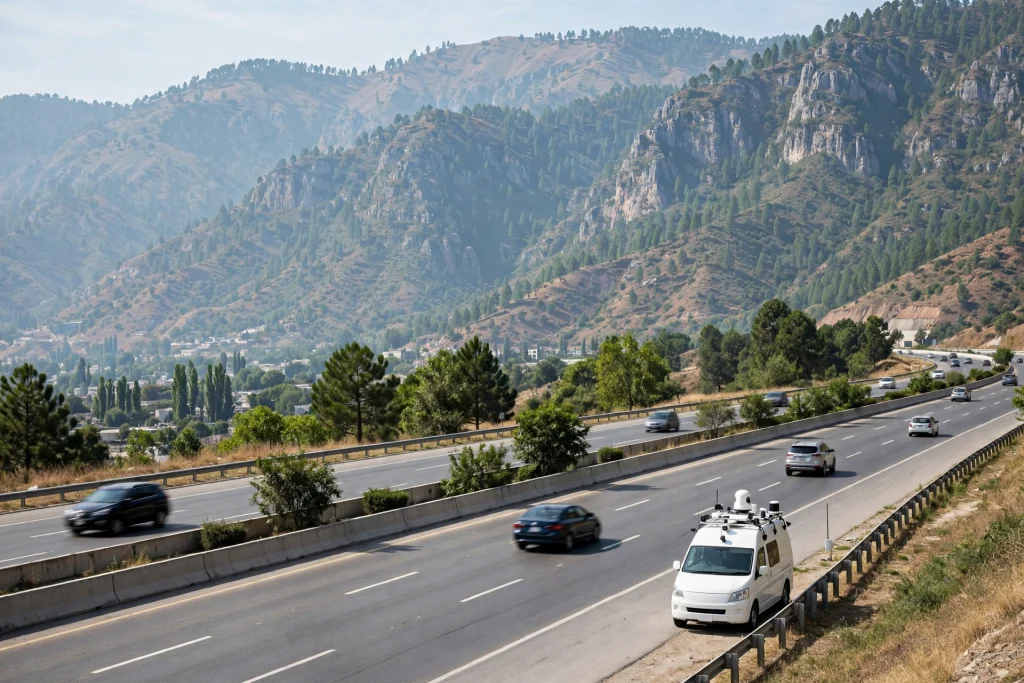
PTA’s chairman went out on the roads himself on 5 November 2026. After weeks of complaints from people in Islamabad and Rawalpindi about weak signals, dropped calls and slow mobile internet, Major General (retd) Hafeez Ur Rehman led teams of PTA officials, ministry representatives and the mobile companies themselves on a field inspection of the twin cities. The teams drove the main roads, checked voice calls and mobile data, and talked to people on the spot.
Two headlines came out of that day, and at first they look like they disagree. PTA’s summary to reporters called the initial results “excellent”. Dawn’s report, published the next morning, said mobile phone service quality in certain areas of Rawalpindi and Islamabad was “not up to mark”. Both are true, and both describe the same exercise. This article explains what the teams actually did, what they found, where the two reports fit together, and — most importantly — what you should do if your own signal is still bad after all of this.
What PTA did on 5 November
PTA launched a special field inspection campaign on Thursday, 5 November 2026, after receiving numerous consumer complaints about mobile voice and data service in Rawalpindi and Islamabad. The chairman personally led the exercise, accompanied by authority members, directors general and senior PTA officials. Representatives of the Ministry of Information Technology, PTA, Jazz, Zong and Ufone took part, and media teams and some of the people who had complained travelled with the inspection teams.
This was not a desk exercise. The teams drove through the two cities in the daytime and tested the service where people actually use it: on the roads, near the airport, and along the main highways. The inspection focused on four things — voice quality, whether calls connect at all, whether calls stay connected once they start, and mobile data speeds.
The chairman also used the trip to speak directly to the operators. On the spot, he issued instructions to the representatives of the mobile companies to fix the problems the teams found. That matters, because it shows this was meant to be a working visit, not a ceremony.
The three routes the teams drove
PTA sent out three teams, and each team covered a different part of the twin cities. The routes were chosen to cover the busiest corridors, not quiet residential streets. Here is where each team went:
| Team | Route covered | Areas checked |
|---|---|---|
| Team 1 | Islamabad International Airport, Srinagar Highway and adjoining areas | Airport road, Srinagar Highway, nearby areas |
| Team 2 | Islamabad Expressway from the city to Rawat T-Chowk | The full Expressway stretch to Rawat |
| Team 3 | Murree Road, Rawal Road and areas around the Old Airport in Rawalpindi | Murree Road, Rawal Road, Old Airport area |
Notice what these routes have in common: they are main roads, highways and the airport. They are the places where thousands of people travel every day, and where a weak signal affects the most users at once. They are not the inside of a house in a side street, a basement shop, or the top floor of a building. That difference matters when you read the results, and we will come back to it.
What the teams actually found
The initial assessment, as reported by Dawn, was that voice and data services were “generally satisfactory in most of the areas inspected” — but the teams identified shortcomings in call quality and internet services in certain areas. In plain words: most of the places they checked were fine, and some places were not.
PTA’s own summary to reporters used a stronger word. TechProlonged reported that PTA called the initial results “excellent”. So the same day produced two descriptions: “excellent” from PTA’s summary, and “not up to mark in certain areas” from Dawn’s report of the findings. Neither side is wrong. PTA was describing the overall picture across the routes it drove. Dawn was reporting the other half of the same finding — that in certain areas, the service did not meet the mark.
This is the honest way to read the exercise: the twin cities’ main corridors are mostly in decent shape, but there are still pockets where calls fail and data crawls. If you live or work in one of those pockets, the word “excellent” will not match your experience, and that does not mean the report is lying. It means the average is hiding the exceptions, and the exceptions are exactly where you are.
The one thing PTA did not publish
Here is the part you should notice. PTA published no speed figures, no call-drop counts and no operator-by-operator comparison from this exercise. There is no number in the public record that says how fast data was on any route, how many calls dropped, or which company performed best according to PTA itself.
That is important, because it means nobody can honestly claim “PTA said Jazz was fastest” or “PTA measured 50 Mbps on the Expressway”. PTA did not say those things. What PTA said, in its summary, was that the initial results were excellent. Everything more specific than that comes from someone else’s reporting, not from PTA.
So if you see a social media post or a shopkeeper quoting exact speeds or a full ranking “from PTA’s 5 November drive test”, treat it with caution. The numbers do not exist in PTA’s published record of this exercise. The real yardstick — the quarterly independent Quality of Service surveys, with proper city reports — is a different exercise, and it is the one to compare when the next round is published.
Jazz on top? That is TechX’s report, not PTA’s
One report did name a winner. TechX reported on 5 November that Jazz emerged as the top performer on speed, voice-call consistency and overall user experience in the PTA Quality of Experience / Quality of Service field exercise that day.
That claim belongs to TechX. It is TechX’s report, based on its own reading of the exercise. PTA itself has published no operator ranking for this exercise, and no other operator was ranked in PTA’s own words. So the fair way to state it is: TechX reports that Jazz topped the exercise. It is not: PTA ranked Jazz first. The difference matters, because a regulator’s ranking and a news site’s report are two different kinds of claim, and only one of them exists here.
None of this takes anything away from the networks. Jazz, Zong and Ufone all sent representatives on the inspection, and all three were part of the exercise. But until PTA publishes its own figures or a ranking, any league table you see is someone else’s version of the day.
Why your signal still drops: the upgrade excuse, explained
When the teams found weak spots, the operators had an explanation ready. Their representatives said the distortions at some towers are happening because the networks are being upgraded — from 3G to 4G, and from 4G to 5G. New equipment is being installed, and newly acquired spectrum is being “sunk” into the network. During that transitional period, service in the affected areas gets worse for a while.
There is truth in that explanation. Upgrading a live network is genuinely disruptive: a tower taken down for new equipment serves nobody while the work is happening, and a new frequency band needs tuning before it performs properly. Anyone who has watched a road being rebuilt while traffic still uses it will understand the idea.
But an explanation is not a fix, and it is not a deadline either. It does not tell you when your street will be back to normal, and it does not mean you should simply wait quietly. The chairman’s on-the-spot instructions to the operators were meant to turn the explanation into action. Whether that action follows is something you can only judge by watching your own signal over the next few weeks — and by complaining properly if it does not improve, which is what the next sections cover.
What this drive test does not prove
Before you decide what the 5 November exercise means for you, it helps to know its limits. A drive test is a useful check, but it is not the final word on network quality, for three reasons.
First, the routes were main roads and the airport. A good result on Srinagar Highway or the Expressway does not guarantee good service at your door. Signals behave differently inside buildings, in basements, on upper floors, and in narrow residential lanes where the nearest tower is blocked by concrete. PTA’s teams did not drive into your street. If your home or shop sits in a shadow between towers, the drive test will not have seen it.
Second, a drive test is a snapshot of one day. Networks change constantly — a tower goes down for maintenance, a new site comes up, load shifts at evening peak hours. A road that tested well at midday on 5 November can still struggle at 8 in the evening when everyone is streaming video. One good drive does not promise a good month.
Third, this exercise is not PTA’s formal yardstick. The quarterly independent Quality of Service surveys, with city-by-city reports, are the numbers that carry weight for comparison. This field inspection was a response to complaints, led by the chairman himself, and its results were reported in words — “generally satisfactory”, “excellent”, “shortcomings in certain areas” — not in figures. Do not present it, and do not let anyone present it to you, as a final verdict on which network is best in the twin cities.
What happened before: the deadline that already expired
This inspection did not come out of nowhere. It follows the story covered in our earlier article on the expired deadline. PTA had told the operators to close the coverage gaps in both cities by the end of October 2026, including along Kashmir Highway and Islamabad Expressway. That deadline expired on 31 October.
PTA’s enforcement director had already run a shorter round of drive tests on 31 October itself, the day the deadline ended. And before that, PTA inspected 184 mobile sites between 22 and 28 October, taking the total number of sites checked past 900. The 5 November exercise, led by the chairman in person, is the follow-up to that deadline: PTA checking for itself whether the work the operators were told to do has actually been done.
That context is worth keeping in mind. The chairman did not go out for a routine visit. He went out because the deadline had passed, complaints were still coming in, and PTA wanted to see the position with its own eyes. The mixed result — mostly fine, some areas not — is the answer to that check.
There is a related but separate story worth one line: PTA has also issued show-cause notices to operators over service problems, including WhatsApp call drops, which we covered in our article on the five notices. That is a different action from this inspection, and it should not be confused with it.
Your signal is still bad? Do this first
If your calls still drop or your data still crawls in Islamabad or Rawalpindi, the drive test result does not fix your phone. But there are steps worth taking before you complain, because some signal problems are in your own handset or settings, not in the network.
First, restart your phone. It sounds too simple to matter, but a restart forces the phone to re-register with the nearest tower, and it clears a stale connection that may be holding you to a distant or overloaded cell. Do it once, properly, and test again.
Second, check whether the problem follows a place or follows you. If your signal is bad only at home but fine outside, the problem is likely coverage at that spot — a building shadow, a basement, or distance from the tower. If it is bad everywhere, the problem may be your SIM, your phone’s settings, or the network itself. That distinction is the first thing any helpline will ask you, so note it down before you call.
Third, check your network mode. In your phone’s mobile network settings, make sure the preferred network type includes 4G (and 5G if your phone and area support it). A phone accidentally set to 3G-only, or a SIM that has never been swapped for a 4G SIM, will crawl no matter how good the towers are.
Fourth, test with another phone on the same network, if you can. If a family member’s phone on the same operator works fine where yours does not, the fault is likely your handset or SIM, not the network. If both struggle, the problem is in the area, and that is exactly what a complaint should say.
Fifth, check whether the problem has a time pattern. If the signal is fine in the morning and terrible after 7 in the evening, that points to congestion — too many users on the same tower at peak hours — which is a network capacity issue, not a fault in your phone. Write down the times. A complaint with times in it is much harder to dismiss than a complaint that just says “signal is bad”.
How to complain to PTA properly
If the problem is in the network and not in your phone, complain — and complain in the right order, with the right details. A vague complaint gets a vague answer. A specific complaint creates a record that PTA can actually act on.
Start with your operator. Call the operator’s helpline and report the problem with the location, the time, and what exactly happens — calls dropping, data not loading, or no signal at all. Ask for a complaint number and write it down. Operators are supposed to resolve service complaints first, and PTA expects you to have tried them before escalating.
If the operator does not fix it, escalate to PTA. You can file a complaint through PTA’s online complaint portal, or call PTA’s helpline at 0800-55055. When you complain, include the details that make the complaint useful: your exact location (area and street, not just the city), the times the problem happens, whether it is voice, data or both, your operator, and screenshots of the signal strength or failed calls if you have them. A complaint that says “Murree Road, near the Old Airport, calls drop every evening after 7 pm” is worth far more than one that says “Rawalpindi signal is bad”.
Keep your complaint number and any reference the operator gave you. If PTA asks for it later, you will have it. And keep testing after you complain — if the problem improves, that is the outcome that matters; if it does not, you can follow up with the same reference instead of starting from zero.
What not to expect from this exercise
It is worth being clear about what the 5 November inspection did not produce, so that nobody is misled — including by this article.
No new deadline was announced. PTA did not say the operators have until a particular date to fix the remaining weak spots, and no new penalty was announced from this exercise. The chairman’s instructions on the spot were instructions to fix the identified issues; they were not a published timetable with consequences attached.
No operator was fined or penalised as a result of this drive test. The show-cause notices PTA issued are a separate matter, covered in our other article, and they should not be mixed up with this inspection.
And no one should promise you that the twin cities’ networks are now fixed. The honest summary of 5 November is the mixed one: generally satisfactory in most areas checked, with shortcomings in certain areas, and work still to do. If your street is one of the certain areas, the only honest advice is to complain properly and keep a record — which is what the steps above are for.
The next real checkpoint is the quarterly independent Quality of Service survey. When its city reports are published, they will give the numbers this exercise did not: speeds, call-drop rates and comparisons between operators, measured the same way across cities. Until then, treat the drive test as what it was — the chairman going out to look for himself, finding a mixed picture, and telling the operators to fix what he found.
The proof for the facts in this article comes from Dawn’s report of the 5 November inspection, which you can read in full at Dawn. It is the primary source for the chairman’s visit, the three routes, and the finding that service was generally satisfactory in most areas but not up to the mark in certain areas.
FAQs
What did PTA actually do on 5 November 2026?
PTA launched a special field inspection campaign in Islamabad and Rawalpindi after numerous consumer complaints. Chairman Major General (retd) Hafeez Ur Rehman personally led three teams that drove the airport and Srinagar Highway, the Islamabad Expressway to Rawat T-Chowk, and Murree Road and Rawal Road in Rawalpindi, testing voice quality, call connection, call continuity and mobile data speeds.
Did PTA say the service was excellent or not up to the mark?
Both descriptions came out of the same exercise. PTA’s summary to reporters called the initial results “excellent”, while Dawn reported that the teams found shortcomings in call quality and internet services in certain areas. The full finding is that service was generally satisfactory in most of the areas inspected, but not up to the mark in certain areas.
Did PTA publish speeds or rank the operators?
No. PTA published no speed figures, call-drop counts or operator-by-operator comparison from this exercise. The report that Jazz topped the exercise comes from TechX, not from PTA. Any speed figure or ranking presented as PTA’s own from this drive test should be treated with caution.
My signal in Islamabad or Rawalpindi is still bad. What should I do?
First check the basics: restart your phone, confirm your network mode includes 4G, and test whether the problem is in one place or everywhere. Then complain to your operator’s helpline with the location, time and details, and note the complaint number. If it is not fixed, escalate to PTA through its online complaint portal or by calling 0800-55055, with the same details plus screenshots if you have them.