
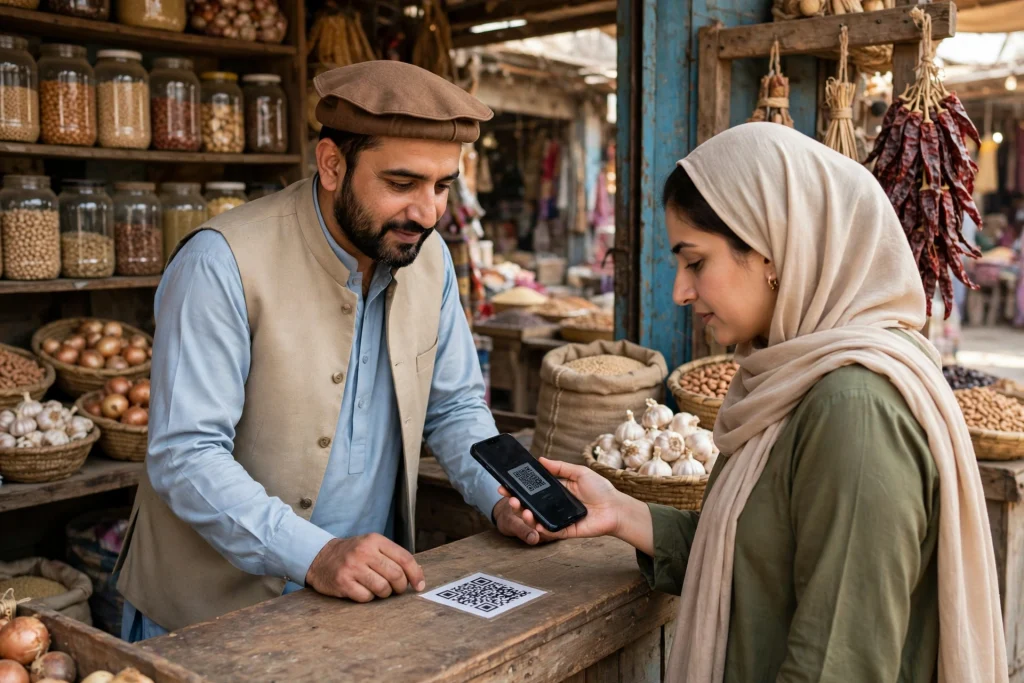
If you run a small shop, a home-based business, or a stall in a busy bazaar, you have probably heard the same advice many times: start accepting digital payments. Customers increasingly want to pay by scanning a QR code or sending money from their phones, and a shop that only takes cash can lose sales. But before you sign up, there is one question every sensible shop owner asks first: what will it actually cost me?
This guide answers that question for the JazzCash Business account. It covers what is free, what each payment method charges, and how much you would pay on a typical amount. Every rate here is given per the current schedule of charges, so you can compare methods before you choose how to accept payments. This guide is about fees only. It does not repeat the merchant-numbers story covered elsewhere on this site; the numbers of shops joining the network are a different topic, and this article stays firmly on what a business account costs to run.
Who Can Open a JazzCash Business Account
Any eligible Pakistani individual with a valid CNIC who runs a business can apply for a JazzCash Business account. You do not need to give up your personal account to do it: a personal account and a business account can both be held on the same CNIC. That matters for small sellers, because it means your shop money and your personal money can live in two separate places under the same identity card.
One caution belongs right here, before the steps. A valid CNIC is mandatory, but JazzCash’s own page also says additional documents may be required depending on the type of business. It does not publish a fixed list of those extra documents. So while most small, individual-run businesses will find the CNIC enough to get started, do not treat “CNIC only, nothing else” as a guaranteed promise for every kind of business. A larger or company-type setup may be asked for more.
How to Open the Account, Step by Step
Basic onboarding is described as taking only a few minutes, although final approval depends on verification checks. The steps are straightforward, and you can do them from your phone:
- Download and open the JazzCash Business app.
- Enter your mobile number and confirm it with the OTP sent to your phone.
- Upload or scan the front and back of your CNIC.
- Enter your CNIC number and its issue date.
- Complete the live photo or biometric check when the app asks for it.
- Fill in your business information.
- Set your MPIN, the PIN you will use to approve transactions.
Once verification is complete, the account is ready to receive payments. Keep your MPIN private, just as you would a bank card PIN, because anyone with it and your phone could move your money.
What Costs Nothing
The first piece of good news is that opening and keeping the account is free. Per the current schedule of charges, Business Account Registration is free, and Business Account Maintenance Charges are also free. In other words, there is no monthly account fee just for having the account open.
Several everyday actions are free as well: SMS alerts, MPIN creation and MPIN change, balance enquiry, and mini and email statements all cost nothing. The Tap on Phone monthly subscription fee is Rs 0. That last point is worth noting, because Tap on Phone — turning an NFC-enabled phone into a card machine — sounds like the kind of feature that would carry a monthly charge. It does not, at least in the current schedule.
The Full Fee Table: Every Method at a Glance
Here is the heart of the guide. The table shows what a merchant pays when a customer pays through each method, and what that means on Rs 100,000 of sales. Read the “including tax” notes carefully: some rates are marked as including FED (Federal Excise Duty), and some are not. Where the schedule does not mark a rate as including tax, the final cost may be slightly higher once tax is added, and this guide does not pretend otherwise.
| Payment method | Merchant fee | What it costs on Rs 100,000 |
|---|---|---|
| Raast QR / Till payment | 0.25% including FED | Rs 250 |
| Customer-to-merchant payment | 0.75% (tax treatment not marked) | Rs 750 |
| Raast Request to Pay | 1% including FED | Rs 1,000 |
| Incoming IBFT (bank transfer) | 2% including FED | Rs 2,000 |
| Funds from a JazzCash account | 2% including FED | Rs 2,000 |
| Tap on Phone (card on NFC phone) | 2% (tax treatment not marked) | Rs 2,000 |
| Other (non-Raast) QR / Till payment | Up to 2.5% including FED | Rs 2,500 |
| Pay via link | 3% (tax treatment not marked) | Rs 3,000 |
The range from 0.75% to 3% that you may have seen quoted elsewhere is simply the span of these method rates, and the table above shows where each number comes from. There is one more rate that sits outside that range and belongs to a different product: JazzCash Khata settlement acceptance on merchant accounts is charged at 1.25% including FED. It is a separate product, not part of the ordinary payment-method list, so do not mix it into the comparison above.
Raast QR: The Cheapest Way to Get Paid
For most small shops, Raast QR is the headline. The standard merchant discount rate on receiving QR and Till payments through Raast is 0.25%, including FED. The arithmetic is simple and worth doing once so you remember it: 0.25% of Rs 100,000 is Rs 250. On Rs 10,000 of sales, the fee is Rs 25. On Rs 50,000, it is Rs 125.
Just as important is who pays. Raast QR payments are free for consumers, which means your customer pays nothing extra for scanning your code. The 0.25% is borne by you, the merchant. That is the normal shape of a card-style fee, and it is the reason Raast QR is the cheapest route in the table: every other method costs a merchant more.
Two honest notes belong here. First, “up to 2.5%” for non-Raast QR is a ceiling, not a fixed rate: the schedule also notes that JazzCash reserves the right to charge lower than the stated fee, so the actual rate for a particular merchant may be less than the maximum. Second, one question the schedule does not answer clearly is which rate applies when a customer paying from a JazzCash wallet scans a merchant’s Raast QR code — the Raast rate or the JazzCash-account rate. That question is genuinely unresolved in the published material, and this guide does not guess at an answer. If that exact situation matters to your shop, confirm it with JazzCash support before you rely on one figure.
The Other Methods, One by One
Raast Request to Pay costs 1% including FED, or Rs 1,000 on Rs 100,000. This is the method where you send a payment request to a customer’s Raast ID or account and they approve it. It costs four times the Raast QR rate, but it is still far cheaper than card-style methods, and it suits businesses that bill customers rather than taking payment at a counter.
Incoming IBFT, where a customer transfers money from a bank account into your business account, costs 2% including FED, or Rs 2,000 on Rs 100,000. Funds received from a JazzCash account into the business account also cost 2% including FED. These two lines look identical in price, but they describe different payment paths, so check which one your customer is actually using before you quote a fee to yourself.
Tap on Phone costs 2% on the headline rate, or Rs 2,000 on Rs 100,000, but remember the tax note: the schedule does not mark this rate as including FED, so the final amount may be slightly higher once tax is applied. The same caution applies to the customer-to-merchant rate of 0.75% and to pay via link at 3%. The schedule’s header says fees are excluding tax unless otherwise mentioned, and only some lines carry an “including FED” note. This guide has kept that distinction visible in the table rather than smoothing it away, because a shop owner budgeting to the last rupee should know which figures are final and which may grow a little with tax.
Pay via link, at 3%, is the most expensive method in the list. It is the option where you send a customer a payment link, often over WhatsApp or SMS, and they pay through it. The convenience of sending a link to a distant customer has a price, and on Rs 100,000 it is Rs 3,000 — twelve times the Raast QR fee. Use it when the customer is not in front of you, but do not make it your default for walk-in sales.
Moving Your Money Out
Receiving payments is only half the story. Sooner or later you will want to move money out of the business account, and those movements have their own charges.
Sending money to another JazzCash account is free. Sending money to any bank account is free up to Rs 50,000 per month; above that monthly limit, the charge is 0.1% or Rs 200, whichever is less. That cap matters: on a Rs 300,000 bank transfer, 0.1% would be Rs 300, but the “whichever is less” rule brings it down to Rs 200. Cash deposit into the business account through an agent or branch costs 0.50%. Cash withdrawal through a JazzCash agent is free per the schedule text, while ATM cash-out costs Rs 35 per transaction. The app and USSD platform fee is Rs 1 per transaction.
For a shop that mostly receives by Raast QR and mostly moves money to a bank account once or twice a month, these out-going charges are small. But if you deposit cash daily through an agent, the 0.50% deposit charge adds up, and it is worth counting in your weekly costs.
Cards for Merchants
JazzCash also offers merchant debit cards. A Mastercard for merchants costs Rs 799 for issuance or replacement. A PayPak card costs Rs 999 for issuance or replacement, with an annual fee of Rs 299. One nuance to keep straight: the schedule says the Mastercard physical-card annual fee is free for merchants, freelancers, employees and corporate customers in one line, while the PayPak annual fee of Rs 299 stands separately. Do not generalise from one card to the other; if you take a PayPak card, budget for its annual fee, and if you take a Mastercard, the annual fee line reads free for merchants.
A Worked Monthly Example
Numbers make more sense in a real month. Imagine a small shop that receives Rs 500,000 in a month, split like this: Rs 300,000 by Raast QR, Rs 100,000 by IBFT from bank accounts, and Rs 100,000 by Tap on Phone card payments.
- Raast QR: 0.25% of Rs 300,000 = Rs 750.
- IBFT: 2% of Rs 100,000 = Rs 2,000.
- Tap on Phone: 2% of Rs 100,000 = Rs 2,000 (before any tax adjustment, since this rate is not marked as including FED).
Total receiving fees: Rs 4,750 on Rs 500,000, which is just under 1% of turnover. Now compare: if the same Rs 500,000 had all come through Raast QR, the fee would have been Rs 1,250. If it had all come through pay via link, it would have been Rs 15,000. The lesson is plain: steering customers toward Raast QR, wherever the customer is willing, is the single biggest fee saving a small shop can make, and it costs the customer nothing extra.
Then add the money-out side. If the shop moves Rs 200,000 to its bank account in that month, the first Rs 50,000 is free, and the remaining Rs 150,000 costs 0.1% (Rs 150) or Rs 200, whichever is less — so Rs 150. A single ATM cash-out adds Rs 35. The whole month’s payment costs, receiving plus moving, stay well under Rs 5,000 on half a million rupees of sales, as long as Raast QR does most of the work.
What This Guide Does Not Claim
Because fee guides are exactly the kind of article where a careless sentence can mislead a shop owner, here is what has deliberately not been claimed. The rates are framed as per the current schedule of charges. The October to December 2026 quarter’s figures have been reported from a bank circular by a secondary source, while the official JazzCash document retrieved for this guide is the previous quarter’s schedule, whose business-section rates are identical. That strongly suggests the rates have continued unchanged, but the current quarter’s circular itself was not retrieved from JazzCash’s own site, so this guide does not present the new quarter’s validity as confirmed from JazzCash’s own document. If you need the current quarter’s circular for a formal purpose, fetch it directly from JazzCash’s website.
Similarly, Raast is designed as an instant-payment rail, so money generally moves fast, but the schedule itself does not state a settlement time for any payment method, and this guide does not promise one. The tax treatment of the 0.75%, Tap on Phone 2%, and pay via link 3% rates is left exactly as the schedule leaves it — unmarked, and therefore possibly excluding tax. And the extra documents that some business types may be asked for at onboarding are not listed, because JazzCash’s own page does not list them.
The fee figures in this guide come from JazzCash’s official schedule of charges, with the current quarter’s rates as reported from the bank’s circular. Check the schedule again before you commit to a method, because schedules are revised quarterly and a rate that is right today can change in the next one.
Also read: JazzCash Crosses 1.9 Million Raast QR Merchants: What It Means for Shoppers and Small Shops and Raast Beginner Guide: Send Money Free With Just a Mobile Number (Pakistan)
FAQs
Is opening a JazzCash Business account really free?
Yes, per the current schedule of charges. Business Account Registration is free and Business Account Maintenance Charges are free, so there is no monthly fee just for keeping the account open. SMS alerts, MPIN creation and change, balance enquiry, and mini and email statements are also free, and the Tap on Phone monthly subscription is Rs 0.
What is the cheapest way for a customer to pay my shop?
Raast QR, by a wide margin. It costs the merchant 0.25% including FED, which is Rs 250 on Rs 100,000 of sales, and it is free for the customer. Every other method in the schedule costs more, from 0.75% for customer-to-merchant payments up to 3% for pay via link.
Do I need anything more than a CNIC to open the account?
A valid CNIC is mandatory, and basic onboarding — app, mobile number and OTP, CNIC scan, CNIC number and issue date, live photo or biometric check, business information, and MPIN — can take only a few minutes, with final approval depending on verification checks. However, JazzCash’s own page says additional documents may be required depending on the business type, without listing them, so a larger or company-type business should be ready for extra document requests.
If a customer pays from a JazzCash wallet by scanning my Raast QR, which rate applies?
The published schedule does not answer this clearly, and this guide does not guess. The Raast QR rate is 0.25% including FED and the JazzCash-account receipt rate is 2% including FED, but which one governs a wallet customer scanning a Raast QR is unresolved in the published material. If this situation is common in your shop, confirm the applicable rate with JazzCash support before budgeting on either figure.