
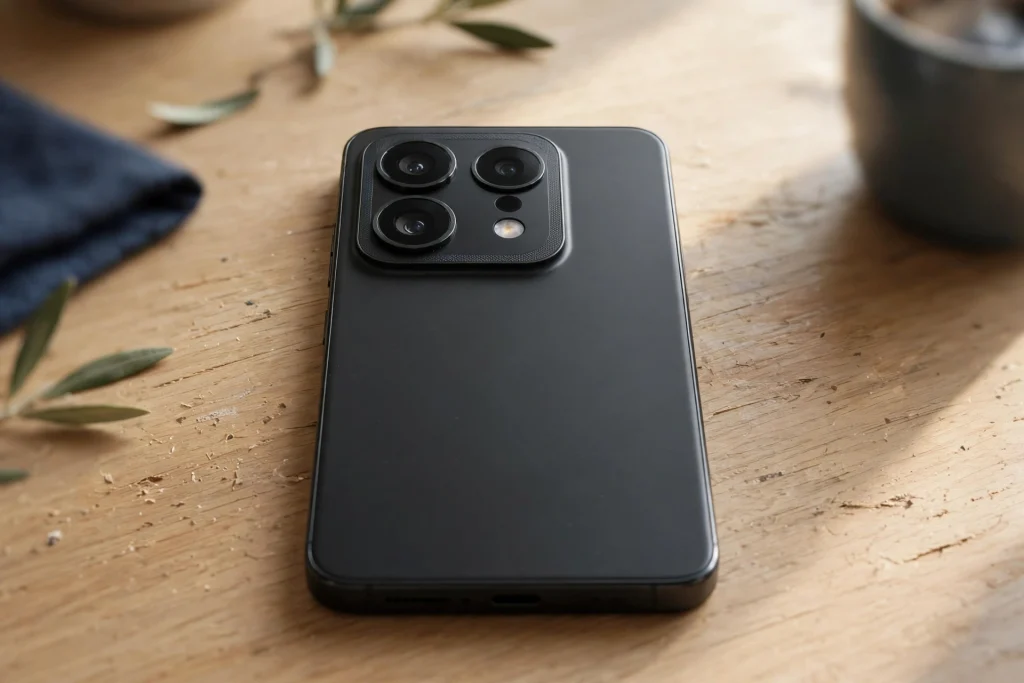
If you search for the POCO X8 Pro price in Pakistan today, you will get an answer that looks confident, and then a second answer that disagrees with it, and then a third answer that disagrees with both. That confusion is not your fault, and it is not a small rounding difference either. The gap between the highest figure and the lowest figure for this phone is Rs 40,000, which is enough money to change whether the phone is good value or not.
So this article does something different from a normal price post. It does not start with one price and pretend the matter is settled. It starts with the disagreement itself, because the disagreement is the story. One tracker says the phone has officially launched in Pakistan with a 12GB RAM and 512GB storage version priced at Rs 189,999, citing a Xiaomi Pakistan official price notice dated 21 October 2026. Other trackers, updated as recently as 25 October 2026, still list the phone as expected-only, with expected prices between Rs 149,999 and Rs 169,999. The same tracker page that reports the Rs 189,999 figure also contradicts itself in its own header and price table. Until a Xiaomi store listing or an official dealer price list settles the question, no single price for the POCO X8 Pro in Pakistan should be treated as final.
That warning matters more than usual here because the POCO X8 Pro is not a small purchase. At any of the prices being quoted, it sits in the upper mid-range, where buyers compare it carefully against other phones from Xiaomi, Samsung, Vivo, and OPPO. Paying an advance, or accepting a shop’s first quote, on the basis of one screenshot could easily cost you tens of thousands of rupees. The safe approach is to understand exactly what each source is saying, what is confirmed, what is still only expected, and what to check in a shop before you hand over any money.
The price disagreement in one view
The table below puts every price figure in one place, with the source and the date attached to it. Notice how the same phone, and even the same website, gives different answers depending on which part of the page you read.
| Source | What it says | Variant | Status |
|---|---|---|---|
| PhoneBolee timeline, 21 October 2026 | Rs 189,999, citing a Xiaomi Pakistan official price notice dated 21 October 2026 | 12GB + 512GB | Officially launched in Pakistan |
| PhoneBolee header, updated 24 October 2026 | Expected Rs 149,999 | Not specified on the header | Market status: Not Launched in Pakistan |
| PhoneBolee price table | Rs 169,999 | 12GB + 512GB | Listed price |
| MobileInto, updated 25 October 2026 | Rs 149,999 expected | 8GB + 256GB | Expected only |
| MobileInto, updated 25 October 2026 | Rs 159,999 expected | 8GB + 512GB | Expected only |
| MobileInto, updated 25 October 2026 | Rs 169,999 expected | 12GB + 512GB | Expected only |
| UrduPoint | Expected Rs 149,999 | 12GB + 512GB | Expected only |
Read that table slowly, because it contains the whole problem. For the same 12GB + 512GB version, three different figures are in circulation at the same time: Rs 189,999 from the PhoneBolee timeline, Rs 169,999 from the PhoneBolee price table and from MobileInto, and Rs 149,999 from UrduPoint and from the PhoneBolee header. The difference between Rs 189,999 and Rs 149,999 is Rs 40,000. The difference between Rs 189,999 and Rs 169,999 is Rs 20,000. Neither gap is small enough to ignore.
The honest summary, in one sentence, is this: a Xiaomi Pakistan price notice is reported to say Rs 189,999 for the 12GB + 512GB version, but trackers still show Rs 149,999 to Rs 169,999 as expected prices, so you should confirm the price with a Xiaomi store before buying. That sentence is the safest way to describe the situation, and it is the sentence you should keep in mind through the rest of this article.
Why one page contradicts itself
It is natural to ask how a single website can say a phone has launched at Rs 189,999 and also say it has not launched yet at an expected Rs 149,999. The answer is that phone tracker pages are not single documents written at one moment. They are pages that get updated in pieces, over time, by different entries. A timeline entry can be added on one day, while the header and the price table still carry older information from an earlier update. When the new entry and the old header disagree, the page ends up telling two stories at once.
That is exactly what has happened here. The PhoneBolee timeline entry dated 21 October 2026 reports the launch and the Rs 189,999 figure. The header, updated on 24 October 2026, still says “Expected Rs 149,999” and “Market status: Not Launched in Pakistan”. The price table on the same page lists the 12GB + 512GB version at Rs 169,999, which is Rs 20,000 below the timeline figure. None of these three parts of the same page agrees with the other two.
MobileInto, updated on 25 October 2026, does not resolve the contradiction either. It still describes the phone as expected to launch in Pakistan, with no official release date announced by Xiaomi Pakistan, and it lists expected prices of Rs 149,999 for 8GB + 256GB, Rs 159,999 for 8GB + 512GB, and Rs 169,999 for 12GB + 512GB. UrduPoint, meanwhile, still lists an expected price of Rs 149,999 for the 12GB + 512GB version. So the tracker picture, taken as a whole, is that the launch is reported in one place and still treated as pending in others.
This kind of split is common in the first days after a phone appears in a market. Official notices, distributor lists, and retail listings do not all update on the same day. Some shops may already be selling the phone while some trackers still show it as expected. Other shops may still be waiting for stock. The mistake is to pick the first number you see and treat it as the market price. The correct approach is to treat all of these figures as claims that need checking, and to give the most weight to a source you can verify yourself, such as a Xiaomi store’s own listing or a written shop quote.
What we checked: Xiaomi and MiStore
Because the Rs 189,999 figure rests on a single tracker timeline entry citing a Xiaomi Pakistan price notice, it was important to try to verify it against Xiaomi’s own channels before writing this article. A search for a Xiaomi or MiStore listing for the POCO X8 Pro in Pakistan was carried out at writing time. No Xiaomi or MiStore product listing for the POCO X8 Pro in Pakistan surfaced in that search, and no second independent source confirming the Rs 189,999 figure beyond PhoneBolee’s timeline entry was found.
That does not mean the Rs 189,999 figure is wrong. It means it is unverified by a second source, and that matters. A price notice quoted by one tracker is not the same as a price you can see on an official store page, and readers deserve to know the difference. If a Xiaomi Pakistan listing appears later, or if an official dealer publishes a price list, that listing should replace the tracker figures as the reference price. Until then, this article leads with the disagreement, exactly as the evidence requires.
There is also a practical lesson here for buyers. When a phone’s price is in this unsettled state, the most reliable check is not another tracker website. It is a direct check: visit a Xiaomi store or an authorised dealer, ask for the POCO X8 Pro by its full name and variant, and ask for the price in writing, with the variant, the warranty terms, and the total amount including any taxes or charges clearly stated. If two shops give you different prices, that tells you the market has not settled yet, and waiting a few days may save you real money. If a shop asks for a full advance payment for a phone it does not have in stock, be extra careful, and do not pay until the variant and the final price are confirmed in writing.
The phone itself: what is agreed
Putting the price argument to one side for a moment, the phone itself is fairly well described across the trackers, and several specifications are consistent. The POCO X8 Pro is a 5G phone running Android 16 with Xiaomi’s HyperOS 3 software. It has a 6.59-inch AMOLED display with a 120Hz refresh rate, a resolution of 1268 by 2756 pixels, and a peak brightness of 3500 nits. A 120Hz display refreshes the screen 120 times per second, which makes scrolling and animations look smoother than on a standard 60Hz screen, and a high peak brightness figure means the screen should stay readable in bright sunlight, although real-world brightness also depends on the content being shown.
Performance comes from the MediaTek Dimensity 8500 Ultra chipset, a modern mid-range to upper mid-range processor built for gaming and heavy multitasking. The phone is listed in three memory and storage versions: 8GB of RAM with 256GB of storage, 8GB of RAM with 512GB of storage, and 12GB of RAM with 512GB of storage. There is no memory card slot listed, so the storage version you buy is the storage you will live with, which makes choosing the right variant more important than it is on phones that accept a microSD card.
The rear camera setup is a 50-megapixel main camera with an f/1.5 aperture and optical image stabilisation, plus an 8-megapixel ultra-wide camera. Optical image stabilisation physically steadies the camera to reduce blur, which is especially useful in low light and for video. The wider f/1.5 aperture lets in more light than a narrower aperture, which should help night photos, although final photo quality also depends on software processing. Charging is listed at 100W wired charging with 27W reverse wired charging, meaning the phone can also charge another device through a cable. The phone is listed in Black, White, and Mint Green colours.
On software support, the PhoneBolee timeline entry from 14 October 2026 reports four generations of Android updates and six years of security updates. That is a long support promise for this price range, and if it holds for the Pakistan version, it is a genuine selling point, because it means the phone should keep receiving new Android versions and security fixes for years after purchase. As with the price, though, buyers should confirm that the support promise applies to the exact version sold in Pakistan, since software support can vary by region.
The specifications that still conflict
Not every specification is agreed, and three conflicts are important enough that they should not be smoothed over. The table below shows them plainly, so that no reader is misled into thinking a single figure is settled when two sources disagree.
| Specification | One source says | Another source says |
|---|---|---|
| Front camera | 20 megapixels (PhoneBolee specifications) | 32 megapixels (UrduPoint) |
| Battery capacity | 6500mAh (PhoneBolee and MobileInto) | 6000mAh (UrduPoint) |
| Dust and water resistance rating | IP69K (PhoneBolee timeline) | IP64 (UrduPoint) |
Each of these conflicts matters in a different way. The front camera affects selfies and video calls, and a 20-megapixel sensor and a 32-megapixel sensor are not interchangeable details. The battery affects how long the phone lasts between charges, and 6500mAh versus 6000mAh is a 500mAh difference, roughly 8 percent, which could mean the difference between comfortably reaching the end of a heavy day and needing a top-up in the evening. The water resistance rating matters even more, because the two ratings describe very different levels of protection. IP69K is a high rating that covers dust and high-pressure water jets, while IP64 covers dust and splashing water only. A buyer who believes the phone has IP69K protection and then exposes it to strong water jets could damage a phone that was only ever rated for splashes.
The careful way to handle these conflicts is to print them, as this article does, and to pick no single figure silently. If you are buying the phone, check the specification sheet on the box or on the official listing for the exact unit you are buying, and pay special attention to the battery and the water resistance rating if either of those affects your decision. Do not rely on a tracker’s specification box alone when two trackers disagree.
Do not confuse it with the POCO X8 Pro Max or the POCO X8s
Phone names in the POCO X8 family are close enough to cause expensive mistakes, so this section is worth reading carefully before you search for prices or visit a shop. The POCO X8 Pro is not the same phone as the POCO X8 Pro Max, and it is not the same phone as the POCO X8s. Mixing them up can lead you to compare the wrong price, the wrong battery, or the wrong phone entirely.
The POCO X8 Pro Max is a different, higher model in the same family. It is listed with an expected price of Rs 169,999 and a much larger 8500mAh battery. Notice the trap here: Rs 169,999 is also the tracker price for the 12GB + 512GB version of the regular POCO X8 Pro on MobileInto and on the PhoneBolee price table. If you see Rs 169,999 attached to a POCO X8 phone, you cannot tell from the price alone which model it refers to. You must check the full model name, because the Pro Max and the Pro are different phones with different batteries and different positions in the range.
The POCO X8s is a separate case again. It is described as a global-only model priced at 440 dollars, with no Pakistan price. A dollar price for a global model should never be converted into rupees by a buyer and treated as a Pakistan price, because the Pakistan price of an officially sold phone includes distributor pricing, warranty costs, taxes, and local market conditions that a simple currency conversion does not capture. If a shop offers you a POCO X8s in Pakistan, ask which model it really is, whether it carries an official Pakistan warranty, and what the total price in rupees is, rather than accepting a converted dollar figure as the price.
When you search online or ask in a shop, always use the full name “POCO X8 Pro”, without “Max” and without “s”, and always confirm the RAM and storage variant. A shop listing that only says “POCO X8” or “X8 Pro” without a variant should be treated as incomplete until the variant is confirmed.
What to check before you buy
Given that the price is unsettled and three specifications conflict, a short buying checklist is more useful than a buying recommendation. Work through these steps in order, and do not skip the first one.
First, confirm the price with a Xiaomi store or an authorised dealer, and get it in writing for the exact variant you want. The 12GB + 512GB version is the one with the Rs 189,999 claim attached to it, but the 8GB + 256GB and 8GB + 512GB versions have only expected tracker prices so far, so all three variants need the same check. Second, confirm what is included in the quoted price. Ask whether the price includes the charger, whether any taxes or extra charges apply, and what warranty you are getting. Third, check the variant on the box before paying. Make sure the RAM and storage on the box match the variant you agreed to pay for, because a 256GB phone and a 512GB phone look identical from the outside.
Fourth, check the specifications that conflict. Look at the battery capacity and the water resistance rating on the official specification sheet for your unit, and do not accept a shop’s verbal assurance on either point if it contradicts the printed sheet. Fifth, compare at least two sellers. In an unsettled market, the first price you hear is rarely the best price, and a second quote can reveal whether the market has settled or is still moving. Sixth, do not pay a large advance for a phone that is not in stock, and do not accept a promise that the price will be confirmed later after you have already paid. The price should be fixed before the money changes hands.
Finally, keep your receipt and the warranty card safe, and keep a note of the shop’s name and the date of purchase. If the official price later settles at a lower figure, you will at least have a clear record of what you paid and when. If a specification turns out to be different from what you were told, that record is what you will need to raise the issue with the seller.
Who should wait, and who can buy now
Whether you should buy now or wait depends on how much the price uncertainty matters to you, and that is a personal decision, but the trade-off can be stated clearly. If you need a phone urgently, and a Xiaomi store confirms a price in writing that you are happy with, for the exact variant you want, with an official warranty, then buying now is reasonable. The phone’s core package, a Dimensity 8500 Ultra chip, a bright 120Hz AMOLED screen, a 50-megapixel stabilised main camera, and 100W charging, is strong for its class, and waiting will not change the hardware.
If you are not in a hurry, waiting is the safer choice. The price gap of up to Rs 40,000 between the reported official figure and the lowest tracker figure is unusually large, and it is likely to narrow as more shops stock the phone and as trackers update their pages to match the real market. A wait of a few days or a couple of weeks could save you a significant amount, and it will also give time for the conflicting specifications to be resolved by an official listing. Waiting also protects you from the most common early-launch mistake, which is paying a launch-week premium for a phone whose price falls once supply becomes normal.
There is one more group of buyers who should definitely wait: anyone who is choosing between the POCO X8 Pro and the POCO X8 Pro Max. Until both phones have settled Pakistan prices, a fair comparison is impossible, because the price difference between them is the main thing that decides which one is better value. Comparing an unsettled price for one phone against an expected price for the other will only mislead you.
How phone prices usually settle in Pakistan
For readers who are new to buying phones in Pakistan, it helps to understand why tracker prices and shop prices often disagree in the first place. Trackers collect prices from many sources, including official notices, distributor lists, and retail listings, and they update their pages at different speeds. A tracker that updates its timeline quickly may report a new official price days before another tracker updates its price table. A tracker that relies on expected prices may keep showing an old estimate until it receives a confirmed figure it trusts.
Shop prices add another layer. Different shops buy stock at different times and at different costs, and they may price the same phone differently depending on whether they have it in stock, whether they are offering an official warranty, and what city they are in. Prices in Karachi, Lahore, and Islamabad can differ on the same day for the same phone. Online sellers add delivery charges and their own margins. None of this means that any single source is dishonest. It means that a phone price in Pakistan is best understood as a range that narrows over time, not as a single number that is true everywhere on the same day.
That is why this article reports a range and names its sources, instead of picking one number and calling it the price. When the range narrows, when a Xiaomi store listing appears, and when shops start quoting the same figure, the price will have settled, and a future update to this article should then report that settled figure. Until that happens, the range is the honest answer.
The price figures and specification details in this article come from PhoneBolee, checked against MobileInto and UrduPoint, and the disagreement between those trackers is reported here exactly as found, including the contradictions inside the PhoneBolee page itself.
FAQs
What is the POCO X8 Pro price in Pakistan?
There is no single settled price yet. PhoneBolee’s timeline cites a Xiaomi Pakistan price notice dated 21 October 2026 giving Rs 189,999 for the 12GB + 512GB version, but the same page’s header still says expected Rs 149,999 and its price table lists the same version at Rs 169,999. MobileInto, updated 25 October 2026, lists expected prices of Rs 149,999 for 8GB + 256GB, Rs 159,999 for 8GB + 512GB, and Rs 169,999 for 12GB + 512GB, while UrduPoint lists an expected Rs 149,999 for 12GB + 512GB. Confirm the price with a Xiaomi store before buying.
Has the POCO X8 Pro officially launched in Pakistan?
The launch is reported but not consistently confirmed. PhoneBolee’s timeline entry dated 21 October 2026 says the phone has officially launched in Pakistan, citing a Xiaomi Pakistan official price notice. However, the same page’s header, updated 24 October 2026, still says “Market status: Not Launched in Pakistan”, and MobileInto, updated 25 October 2026, still describes it as expected to launch. No Xiaomi or MiStore listing for the phone in Pakistan was found at writing time, so the launch should be treated as reported rather than fully settled.
Why do different websites show different POCO X8 Pro prices?
Because tracker pages update in pieces and at different speeds, and because shop prices vary by stock, warranty, and city. In this case, one tracker added a timeline entry reporting Rs 189,999 while its own header and price table still carried older figures of Rs 149,999 and Rs 169,999, and other trackers had not yet moved from expected prices to a confirmed price. Until an official Xiaomi listing or dealer price list appears, the different figures reflect different update stages, not different phones.
How is the POCO X8 Pro different from the POCO X8 Pro Max and the POCO X8s?
They are three different phones, and the names should not be mixed up. The POCO X8 Pro Max is a different, higher model with an expected price of Rs 169,999 and a larger 8500mAh battery. The POCO X8s is a global-only model priced at 440 dollars with no Pakistan price, so its dollar price should not be converted into rupees and treated as a Pakistan price. Always check the full model name and the RAM and storage variant before comparing prices or buying.
Also read
Motorola Moto G37 5G Price in Pakistan: Rs 59,999, Specs and PTA Status
Redmi Note 14 Price in Pakistan: The 4G Model Is the Official One (Specs, Prices, 5G Warning)