
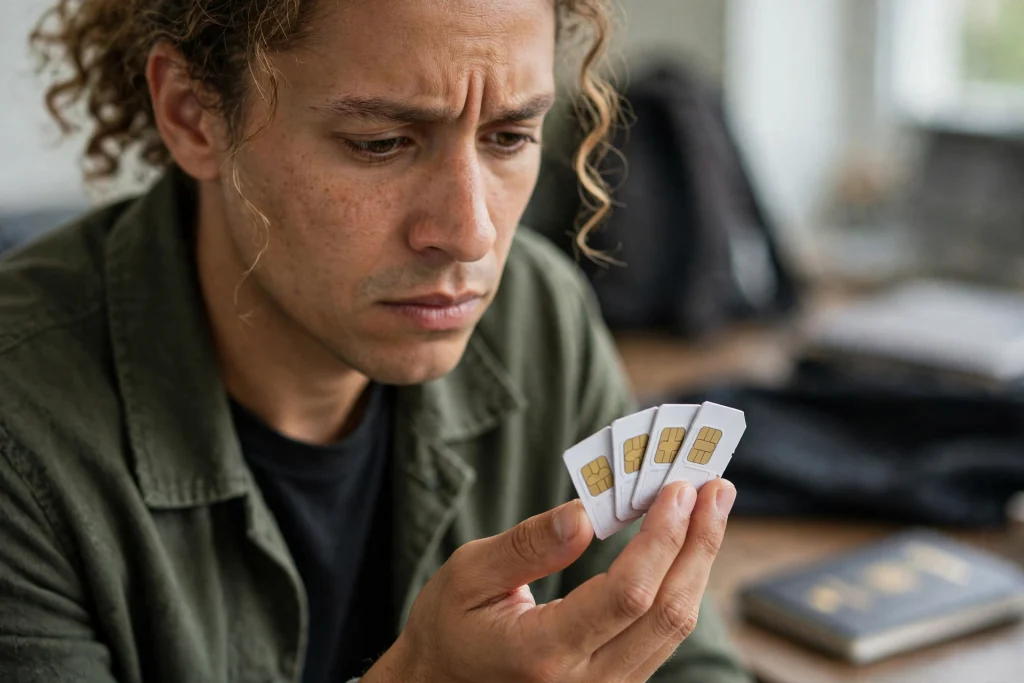
If someone offers you a cheap SIM card from another country in a market in Pakistan, or a friend forwards you a deal for a foreign number that “works without registration”, stop before you buy it. The Pakistan Telecommunication Authority (PTA) has issued a fresh warning against the illegal buying and selling of foreign SIM cards in Pakistan, as reported on 2 November 2026. The warning is about security, and it is about the law. This guide explains what the warning actually says, who it does and does not apply to, and how to stay on the safe side.
The most important point first: this warning is not about every foreign SIM. It is not a ban on roaming. If you are a tourist visiting Pakistan and you are using your own home-country SIM on roaming, or you are an overseas Pakistani who is using your own foreign number while you are here, you are not the target of this warning. The target is the illegal trade in foreign SIMs inside Pakistan — SIMs bought from unauthorised sellers, often registered in someone else’s name or not properly registered at all, and then used or sold onward here.
What PTA Has Warned About
According to the report of the advisory, PTA has warned against the illegal buying and selling of foreign SIM cards in Pakistan, citing serious security threats and possible legal consequences. The concern is straightforward. A SIM card is an identity. When you make a call, send a message, or open a mobile account, the network knows which SIM was used. If that SIM is registered in your name through proper verification, the trail leads to a real person. If it is a foreign SIM that was traded illegally and is not tied to the person using it, that trail goes cold.
PTA’s reasons, as reported, are that foreign SIMs sold this way can be exploited for financial fraud, identity misuse, and other criminal activity, and that they make it hard to identify the people behind unlawful communications. That is the core of the problem. A fraudster who wants to run a scam does not want a number that points back to them. A SIM bought from an unauthorised seller, registered in someone else’s name, or brought in through unofficial channels gives them exactly that kind of cover.
This is also why the warning matters to ordinary users, not just to criminals. If a SIM is not registered in your own name, you have no real control over it. The person whose name it is registered under could report it, block it, or misuse the account attached to it. And if the SIM is ever used for something illegal, the first questions will go to the name on the registration, not to the person who actually held the phone. Buying a cheap foreign SIM can therefore put you in the middle of someone else’s problem.
Who Is NOT the Target of This Warning
Confusion around this story is easy, so let us be clear about who is not affected.
First, legitimate international roaming is not banned by this advisory. The advisory announces no blanket ban on roaming. If you arrived in Pakistan with your own SIM from your home country and your phone connects to a Pakistani network through your home operator’s roaming agreement, that is a normal, legal arrangement. Your home operator knows who you are, the SIM is registered in your name, and the roaming partner network can see the connection. That is the opposite of an anonymous, illegally traded SIM.
Second, this warning is a different PTA action from other SIM-related news you may have seen. It is not the same as the PTA action against WhatsApp accounts linked to inactive SIMs, it is not the 180-day prepaid balance rule, and it is not the shutdown order affecting the ONIC operator. Each of those was a separate matter with its own rules. This warning is specifically about the illegal trade in foreign SIM cards.
Third, the warning is not aimed at people who simply own a foreign SIM. Owning a SIM from another country is not, by itself, the offence described here. The problem is buying or selling such SIMs illegally in Pakistan — through unauthorised sellers, without proper registration in the buyer’s own name.
Legal vs Illegal: The Simple Test
The table below sums up the difference. It is the whole story in one glance.
| SIM situation | How it was obtained | Risk attached |
|---|---|---|
| Legal local SIM | Bought from an authorised operator outlet or franchise, registered in your own name through proper verification | None from this warning — this is the normal, safe route |
| Legal roaming SIM | Your own home-country SIM, registered in your name, used on roaming through your home operator | None — roaming is not banned by this advisory |
| Illegal foreign SIM | Bought from an unauthorised seller in Pakistan, or registered in someone else’s name, or traded without proper verification | Security risk, fraud and identity-misuse risk, and possible legal proceedings |
| Resold or shared SIM | A SIM passed on to another person after registration, so the user and the registered owner are different people | The registered owner and the user can both face trouble if the SIM is misused |
The rule that comes out of the table is simple: a SIM should be bought from an authorised outlet and registered in your own name. If a seller cannot do that for you, walk away. That is the only official route the advisory points to, and there is no shortcut that makes an illegally traded SIM safe.
Why an Illegally Traded Foreign SIM Is Dangerous
There are three dangers, and they are worth understanding separately, because each one affects a different kind of user.
The first danger is fraud. A SIM that cannot be traced to its real user is a useful tool for scams. Fraudsters use such numbers to run fake calls, phishing messages, and financial fraud, because victims and investigators cannot easily find out who is behind the number. When you buy such a SIM, even for an innocent reason such as cheap calls, you are holding the same kind of untraceable connection that scammers prefer. If that number was previously used for fraud, or is later linked to a fraud case, you may have to explain a connection you never made.
The second danger is identity misuse. A SIM registered in someone else’s name means someone else’s identity is attached to your calls and messages. That person could be a stranger, a stolen identity, or a name invented by the seller. If that identity is later flagged, the SIM can be blocked without warning, and any account or service tied to the number — a bank alert, a WhatsApp account, a social media login — can be lost with it. You also have no way to prove the number is yours, because on paper it belongs to someone else.
The third danger is legal trouble. PTA has previously warned that people involved in illegal foreign SIM trading may face legal proceedings, and that consequences could include fines, imprisonment, or service disconnection. Note carefully: the latest advisory itself specifies no new penalty amounts. No fine figure should be quoted from this warning, because none was given. But the direction is clear — this is treated as a legal matter, not just a telecom rule, and the consequences described in earlier warnings are serious.
The Scale of the Problem
This warning did not come out of nowhere. The same report notes that during the first seven months of 2026, authorities blocked more than 1.83 million SIM connections linked to registration violations. That is a very large number, and it tells you two things. First, registration violations are a real, large-scale problem, not a rare edge case. Second, enforcement is active: connections that break the registration rules are being found and blocked.
For an ordinary user, the practical meaning is simple. A SIM that looks like a bargain today can stop working tomorrow if it is blocked in one of these enforcement rounds. Money spent on it, contacts saved to it, and accounts linked to it can all be disrupted at once. A legally registered SIM does not carry that risk.
Red Flags: How to Spot an Illegal Foreign SIM Offer
Illegal SIM offers usually share a few warning signs. Watch for any of these:
- The seller cannot or will not register the SIM in your own name at the time of sale.
- The price is far below normal, and the seller explains it away with vague claims about “special stock” or “no registration needed”.
- The seller asks you to pay in cash with no receipt, no shop name, and no way to contact them afterwards.
- The SIM is already active when you receive it, with no verification step involving your own identity document.
- The seller offers to register the SIM under someone else’s name, or tells you registration “is not needed for foreign SIMs”.
Any one of these is a reason to walk away. A genuine, authorised outlet does the opposite: it verifies your identity, registers the SIM in your name, and gives you a record of the sale. If the deal cannot pass that test, it is not a deal worth taking.
What to Do If You Already Have One
If you already bought a foreign SIM from an unauthorised seller, do not panic, but do not keep using it as if nothing is wrong either. The safest steps are straightforward.
First, stop using it for anything important. Do not link it to a bank account, a payment wallet, or any account you cannot afford to lose. Second, do not sell it onward or pass it to someone else. Passing an illegally traded SIM to another person only spreads the problem and can make you part of the chain. Third, get a proper SIM through the legal route: buy from an authorised operator outlet and make sure it is registered in your own name through proper verification. Move your important accounts to that number.
If you are unsure about the status of a SIM, or you want to report a seller who is offering illegal foreign SIMs, you can contact PTA on its helpline 0800-55055. That number is already the established PTA helpline for SIM-related complaints, and it is the quickest official channel for this kind of report. You do not need to go through a long complaint process to ask a simple question about a SIM’s status.
Safe Alternatives That Actually Work
There is no need for an illegally traded foreign SIM, because the legal alternatives cover the same needs.
If you live in Pakistan, buy a local SIM from an authorised outlet in your own name. It is the cheapest, safest, and most reliable option, and it works with every local service, from mobile banking to government apps, without any registration risk.
If you are visiting Pakistan, use your own home-country SIM on roaming, or buy a local SIM legally on arrival with your passport and proper verification. Both routes are normal and accepted, and neither is affected by this warning.
If you are an overseas Pakistani returning home, the same applies: your own roaming SIM is fine, and a local SIM bought legally is the simplest long-term option. The warning is aimed at the illegal trade, not at people who follow the normal process.
The Bottom Line
PTA’s warning, as reported on 2 November 2026, is a reminder of a basic rule that has always applied to SIMs in Pakistan: buy from authorised outlets, and make sure the SIM is registered in your own name. Foreign SIMs traded illegally break both parts of that rule, and that is why they carry fraud risks, identity risks, and legal risks. No bargain price changes that calculation, because a blocked SIM, a lost account, or a legal problem costs far more than whatever was saved at the counter.
If a seller cannot register a SIM in your name, the answer is simple: walk away, buy legally, and keep your number — and your identity — properly in your own hands.
The warning was reported by The Truth International, which covered PTA’s public advisory on foreign SIM cards and the enforcement figures behind it.
FAQs
Is it illegal to use a foreign SIM in Pakistan?
No, not in general. Using your own home-country SIM on roaming is legitimate and is not banned by this advisory. What PTA has warned against is the illegal buying and selling of foreign SIMs in Pakistan through unauthorised sellers, especially when the SIM is not registered in the user’s own name.
Can I be fined for buying a foreign SIM from a shop?
PTA has previously warned that people involved in illegal foreign SIM trading may face legal proceedings, including fines, imprisonment, or service disconnection. However, the latest advisory itself specifies no new penalty amounts, so no specific fine figure applies to this warning. The risk is real, but the exact penalty would depend on the case and the law applied.
How can I check if a foreign SIM is legal?
There is no shortcut beyond the official route: buy from an authorised outlet and make sure the SIM is registered in your own name through proper verification. If a seller cannot do that, the SIM should not be bought. If you are unsure about a SIM you already have, you can contact PTA on 0800-55055.
What should I do if a seller offers me a cheap foreign SIM without registration?
Walk away and do not buy it. Do not pay cash for a SIM with no receipt and no registration in your name, and do not pass such a SIM on to anyone else. Buy a legal SIM from an authorised outlet instead, registered in your own name.