
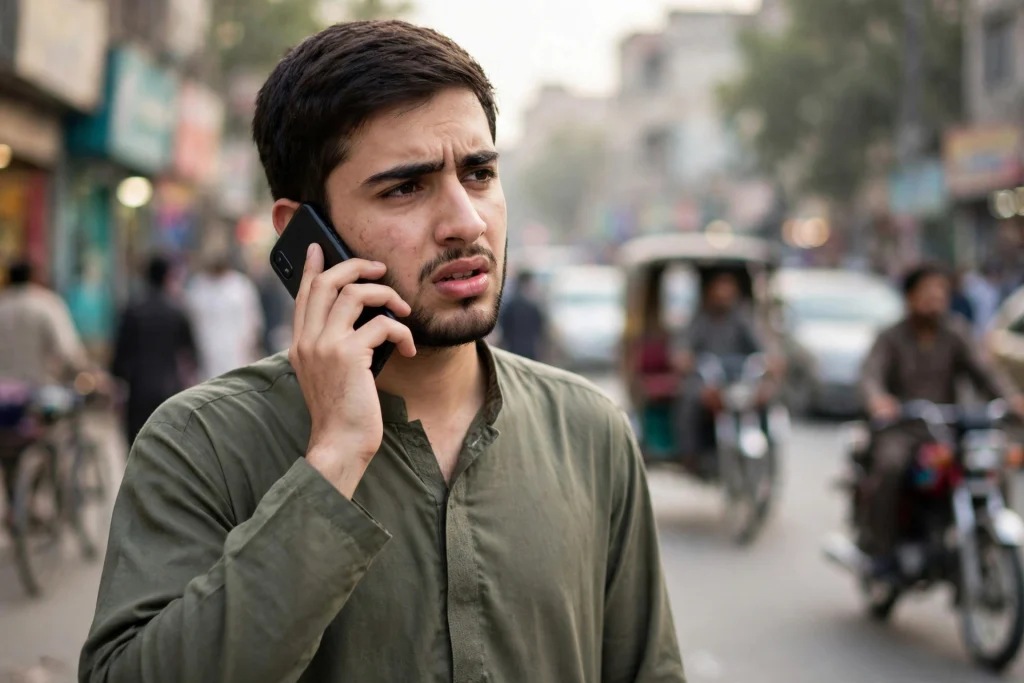
Your WhatsApp call is going fine, and then suddenly the voice freezes, breaks up, or the call just ends. You call back, and it happens again. You switch from mobile data to Wi-Fi, or from Wi-Fi to mobile data, and sometimes it helps, and sometimes it does not. If this sounds familiar, you are not alone, and the problem has now reached Parliament. On Tuesday 3 November 2026, members of the National Assembly Standing Committee on IT and Telecom told the Pakistan Telecommunication Authority (PTA) that WhatsApp calls keep dropping, even in Islamabad. One member said WhatsApp calls disconnect even in Islamabad, and that networks barely work all the way from his constituency to Karachi.
The good news is that PTA is not ignoring the problem: at the same meeting, the PTA chairman said PTA has issued five show-cause notices to telecom operators over poor service in the last three months. The bad news is that no fine has been recovered yet, because the operators went to court and got stay orders. A show-cause notice has legal force, but it is not a fine paid, and it does not fix your connection by itself. This article explains what happened, what a show-cause notice means, why WhatsApp calls drop even when normal calls work, the fixes to try now, and how to complain properly, first to your operator and then to PTA.
What Happened on 3 November 2026
The National Assembly Standing Committee on IT and Telecom held its 25th meeting on Tuesday 3 November 2026, in Committee Room 7 at Parliament House in Islamabad. The meeting was chaired by MNA Syed Amin ul Haq, and the main item was the poor quality of internet and mobile services in Pakistan, a subject that affects almost every household, because so much daily life now runs through a phone: work calls, online classes, mobile banking, and family chats.
PTA Chairman Maj Gen (retd) Hafeez ur Rehman briefed the committee. He said PTA had directed operators to improve their Quality of Service within three months in areas where PTA surveys had found deficiencies, and where service did not improve, PTA issued show-cause notices. In total, five show-cause notices went to telecom operators over poor service in the preceding three months. A show-cause notice is a formal legal step in which the regulator tells an operator it has found a problem and asks the operator to explain why action, including a fine, should not be taken against it.
Committee members did not hold back. They raised frequent WhatsApp call signal drops, including in Islamabad and Karachi, the two cities where networks are supposed to be strongest. Member Ahmed Ateeq said networks barely work from his constituency to Karachi, and that WhatsApp calls disconnect even in Islamabad. That matters: the problem is not limited to remote areas, and when a member of Parliament says his own calls drop in the capital, the problem is in the heart of the network.
PTA pointed to reasons beyond the operators’ direct control: prolonged power outages, with cuts of 12 to 16 hours cited, which knock out towers that depend on electricity and backup power, and the theft of telecom infrastructure, including towers, diesel, and generators. These are real problems, but they do not change the fact that users are paying for a service and not getting the quality promised, and that is why the committee pressed PTA for action rather than explanations.
| What happened | The detail |
|---|---|
| Meeting | National Assembly Standing Committee on IT and Telecom, 25th meeting, Tuesday 3 November 2026, Committee Room 7, Parliament House, Islamabad |
| Chair | MNA Syed Amin ul Haq |
| Who briefed the committee | PTA Chairman Maj Gen (retd) Hafeez ur Rehman |
| Show-cause notices | 5 issued to telecom operators over poor service in the preceding three months, after operators were told to improve Quality of Service within 3 months where surveys found deficiencies |
| Complaints raised | Frequent WhatsApp call signal drops, including in Islamabad and Karachi; Ahmed Ateeq said WhatsApp calls disconnect even in Islamabad |
| Reasons given by PTA | Prolonged power outages (12 to 16 hour cuts cited) and theft of telecom infrastructure, including towers, diesel, and generators |
| Operators named? | No — the operators were not named, so this article does not name any operator |
| Fine amounts | Not given — no amounts were stated, so this article quotes none as an imposed fine |
What Is a Show-Cause Notice, and Why Has No Fine Been Paid Yet
A show-cause notice is often misunderstood, so it is worth explaining in simple words. When PTA issues one, it tells an operator: we have found that your service falls short of the required standard, and you must explain why we should not punish you. The operator gets a chance to reply, and after that PTA can decide on a penalty. So a show-cause notice is the start of a legal process, not the end of it. It is stronger than a warning letter, because it opens the door to a fine, but it is not a fine itself.
That is why the next fact from the meeting is so important. The PTA chairman told the committee that no fines have been recovered yet, because the operators went to court and obtained stay orders. A stay order pauses the recovery of a fine while the case is being heard, so the fines exist on paper but the money has not been collected. According to CW Pakistan, fines under the applicable rules can reach up to Rs 350 million. That is the maximum the rules allow, not the amount of any fine in these five cases, because the actual fine amounts were not given. Do not let anyone tell you that a particular operator has been fined a particular amount in this matter, because that information was not made public.
This is not a new pattern. According to CW Pakistan, based on a minister’s written reply in February 2026, PTA recovered only Rs 13.6 million out of Rs 68.9 million in penalties imposed over the last five years, about 19.7 percent. In the same period, PTA issued 39 show-cause notices and 18 warning letters, and 11 cases were under court consideration. PTA does act, but collecting the money is slow, and many cases end up stuck in court.
So what should you take from this? Your complaint is being heard at the highest level, and even members of Parliament face the same dropped WhatsApp calls. The five notices show PTA is using its powers, but the stay orders show enforcement is slow and contested. And a show-cause notice does not fix anyone’s connection. Your call will still drop tonight unless something changes on the ground, either in your own phone settings or in the network in your area. That is why the rest of this article focuses on what you can actually do.
Why WhatsApp Calls Drop Even When Normal Calls Work
Many people are confused by one thing: their normal phone calls work fine, but their WhatsApp calls keep dropping. The answer is simple. WhatsApp calls do not run on the voice network. They run on mobile data, on the internet connection of your phone. A normal call uses the old voice network, which needs very little signal to work. A WhatsApp call needs a steady, continuous data connection, and if that connection is weak, congested, or unstable, the call will freeze, break up, or disconnect, even when the signal bars on your phone look fine.
Think of it like this. A normal phone call is like a narrow pipe that only needs a trickle of water. A WhatsApp voice call needs a steady flow, and a video call needs an even stronger flow. If the flow keeps stopping and starting, the call suffers. The signal bars mostly show voice coverage, not data quality, so four bars do not guarantee a good WhatsApp call.
A data connection can be weak for several reasons in Pakistan. The tower near you may be overloaded, especially in the evening when thousands of people in your area use the internet at once. It may be running on backup power during a long electricity outage, or far away, or blocked by buildings, hills, or thick walls. Your own phone may be the problem too: an old WhatsApp version, a battery-saver mode that limits data, a VPN in the background, or a low-data setting that squeezes the call too hard. Sometimes the problem is on WhatsApp’s own side, or between your operator and the wider internet, which is why your call can fail while your neighbour, on a different operator, has no problem.
If your normal calls also drop, the problem is probably the network in your area, and complaining to your operator is the right step. If only your WhatsApp calls drop, the problem may be your data connection, your phone settings, or your Wi-Fi, and the fixes below are the right place to start.
Try These Fixes First, in This Order
Work through these steps one by one, and test a WhatsApp call after each step. Do not change five things at once, because then you will not know which one fixed the problem. Menu names can differ slightly between phone brands and WhatsApp versions, so confirm each step in your own WhatsApp app before assuming it looks exactly as described here.
- Switch between Wi-Fi and mobile data. If the call keeps dropping on Wi-Fi, turn Wi-Fi off and try mobile data, or the other way round. If it works on one and not the other, you have found the problem.
- Toggle airplane mode on and off. Turn airplane mode on, wait about ten seconds, then turn it off. This forces your phone to disconnect from the tower and reconnect fresh.
- Check your signal and move to a better spot. If you see only one bar, or the data icon keeps switching between 4G and 3G, move near a window or step outside. Thick walls, basements, and lifts are the worst places for a WhatsApp call.
- Restart your phone. A restart clears temporary glitches and closes apps using data in the background. If you have not restarted your phone in days, do it now.
- Update WhatsApp. Open the Play Store or the App Store and check whether a WhatsApp update is available. Old versions can have call bugs that newer versions have fixed. Also check that your phone’s own software is up to date.
- Check low-data settings. In WhatsApp, open Settings, then Storage and data, and look at the call and data options. If a low-data setting for calls is on, try turning it off, along with your phone’s own Data Saver or Low Data Mode.
- Close heavy apps and pause downloads. If another app is downloading a large file or streaming video during your call, it competes for the same data connection. Pause downloads and close video apps, then test the call again.
- Turn off your VPN, if you use one. A VPN sends all your internet traffic through an extra server, which adds delay and can make a voice call unstable. Turn it off and test the call.
- Try a different network or location. If you have a second SIM, try the call on the other operator’s data. If it works on one operator and not the other, you have found a network problem, and that is exactly the detail your complaint should include.
- Reinstall WhatsApp only as a last step. Back up your chats first, then delete WhatsApp and install it again from the official store. Do it last, because you must back up first or you can lose messages and media.
If one of these steps fixes your calls, you have your answer. If the calls still drop after all ten steps, on both Wi-Fi and mobile data, in different places, and on a fully updated phone, then the problem is almost certainly the network in your area, and the complaint steps below are the right next move.
Is It Your Phone, Your Network, or an Outage?
Before you complain, spend two minutes deciding where the problem actually is. Complaining about your phone to your operator will not help if the phone is the problem, and reinstalling WhatsApp will not help if the tower in your area is down.
| Symptom | Likely cause | What to try first |
|---|---|---|
| WhatsApp calls drop, but normal calls work | Weak or unstable data connection, not the voice network | Switch between Wi-Fi and mobile data, toggle airplane mode, move near a window |
| Calls drop on Wi-Fi only | Your Wi-Fi router or broadband line | Restart the router, move closer to it, test on mobile data |
| Calls drop on mobile data only | Your operator’s data coverage or tower congestion | Try another location, test a second SIM |
| Calls drop everywhere, on every network | Your phone or WhatsApp app | Restart the phone, update WhatsApp, check low-data settings |
| Calls drop only in the evening | Tower congestion at peak hours | Test in the morning; note the time pattern in your complaint |
| Calls drop during long power cuts | Tower on weak backup power or switched off | Test again when power returns; mention it in your complaint |
| Voice breaks up but video fails completely | Data speed enough for voice, not for video | Switch to a voice call, move to a stronger signal spot |
| Everyone in your area has the same problem | A local network or tower fault | Complain to your operator with your area name, then escalate to PTA |
Two more checks are worth doing. First, ask a family member or neighbour on the same operator whether their WhatsApp calls drop too. If they do, the problem is in your area, not in your phone. Second, note whether the problem started on a particular day, or after a storm, a long power cut, or a phone update. A clear start date makes your complaint much stronger, because the operator can check what changed in its network on that day.
How to Complain So It Actually Gets Recorded
Many users complain about poor service in a way that goes nowhere. They tell a shopkeeper, they post on social media, or they call the helpline once and give up. None of that creates a proper record. If you want your complaint to count, follow the proper order: complain to your operator first, keep the reference number, and only then escalate to PTA, quoting that reference number. That order matters, because PTA will ask whether you gave the operator a chance to fix the problem first.
Start with your operator’s helpline or its official app. Explain the problem clearly: WhatsApp calls drop, normal calls work, and you have already tried the fixes, including switching between Wi-Fi and mobile data and restarting your phone. Give the details that help the operator find the fault: your area and street, the times when calls drop most, whether the problem happens on mobile data or Wi-Fi or both, and whether your neighbours have the same problem. Ask for a complaint reference number, and write it down with the date and time of your call. Keep a short diary for a week: the date, the time, and what happened on each dropped call. A diary turns a vague complaint into evidence.
Give the operator a reasonable time to respond, and call back with your reference number if nothing improves. If the operator does not fix the problem, escalate to PTA through its complaint portal, quoting your operator’s reference number, the dates of your calls, and the details from your diary. For the full step-by-step walkthrough, read our guide on weak signals and dropped calls. One complaint alone may not change much, but hundreds from the same area tell PTA exactly where the network is failing, and the five show-cause notices in this article came after PTA surveys found deficiencies.
What PTA Found in Its Inspections
The committee meeting also covered PTA’s own inspection work, which is how the authority checks whether operators are actually delivering the service they promise. The PTA chairman told the committee that he had visited 41 districts along with the operators to check service on the ground. Separately, a PTA press release dated 30 October 2026 said PTA inspected 184 mobile sites between 22 and 28 October 2026, and that the total number of sites checked had gone past 900. Do not mix this with a different round reported elsewhere, which mentioned 115 sites checked between 30 September and 7 October. That was a different round, not the same count.
The Scale of the Problem: 100 Million WhatsApp Accounts
The same briefing gave a sense of how big WhatsApp has become in Pakistan. According to the figures given by the PTA chairman in his statement to the committee, Pakistan has 100 million WhatsApp accounts, with around 12 billion WhatsApp messages and 1 billion calls a day. Those numbers are the chairman’s statement, not a published dataset, and there are no published minutes behind them that readers can check, so read them as his account of the scale of use, not as verified official statistics. Even so, they explain why this is a national problem: when a service carries a billion calls a day, even a small failure rate means millions of failed calls.
The chairman also gave figures for other platforms: 96 million YouTube users, watching around 560 million videos a day, which he called the highest national YouTube viewership in the world. That last claim is his, and it has not been independently verified, so this article reports it as his claim, not as a confirmed fact. For TikTok, the briefing put the figure at around 100 million registered accounts, and this article quotes it no more precisely than that, because published accounts of the briefing differ on the TikTok measure. A dropped WhatsApp call today can mean a missed business order, a missed class, or a missed call with family abroad.
What a Show-Cause Notice Will Not Do for You Today
It is important to be clear about this, because headlines can be misleading. A show-cause notice does not fix anyone’s connection. It does not make your next WhatsApp call work, and it does not refund the mobile data you wasted on failed calls. It is a legal step against an operator, and it may lead to a fine that may one day be collected, but none of that helps you tonight. What helps you tonight is the checklist in this article: switch networks, toggle airplane mode, restart your phone, update WhatsApp, and check your settings. What helps you this week is a proper complaint to your operator, with a reference number and a diary of dropped calls.
Readers in Islamabad and Rawalpindi should also read our report on the PTA twin-cities network deadline, which explains what happened when an earlier PTA deadline for those two cities expired, and what users there can expect next. The lesson of that earlier deadline is the same as the lesson of this meeting: deadlines and notices are useful, but they only work when they are followed up, and when users keep the pressure on with proper complaints.
In the end, the story of 3 November 2026 is hopeful, but only in a limited way. It is hopeful because dropped WhatsApp calls were raised in Parliament by members who face the same problem themselves, and PTA has issued five show-cause notices in three months. It is limited because no fine has been recovered, the operators are not named, and the amounts are not public, and the last five years show recovery is slow and often stuck in court. The best response is practical: fix what you can on your own phone, complain properly where you cannot, and keep a record. That is how a personal problem with dropped calls becomes part of a national record that PTA and Parliament cannot ignore.
For the committee meeting details in this article, including the 3 November 2026 date, the five show-cause notices, the stay orders on fines, and the members’ complaints about WhatsApp call drops in Islamabad and Karachi, see the report by UrduPoint, and note that the operators were not named and the fine amounts were not given in that report, so this article does not name any operator or quote any fine amount as imposed.
FAQs
Why do my WhatsApp calls keep dropping in Pakistan even though normal calls work?
WhatsApp calls run on mobile data, not on the voice network, so a weak or unstable data connection can freeze or cut a WhatsApp call even when a normal call works fine. Try switching between Wi-Fi and mobile data, toggling airplane mode, moving to a stronger signal spot, and turning off low-data mode for calls. If calls still drop on both Wi-Fi and mobile data in different places, the problem is probably the network in your area, and you should complain to your operator.
What did PTA say about WhatsApp call drops on 3 November 2026?
At the National Assembly Standing Committee on IT and Telecom meeting on 3 November 2026, PTA Chairman Maj Gen (retd) Hafeez ur Rehman said PTA had issued five show-cause notices to telecom operators over poor service in the preceding three months. Committee members raised frequent WhatsApp call signal drops, including in Islamabad and Karachi, and member Ahmed Ateeq said WhatsApp calls disconnect even in Islamabad. The operators were not named and the fine amounts were not given.
Has PTA fined the operators for poor service?
PTA has issued show-cause notices, which are a formal step that can lead to a fine, but no fines have been recovered yet in these cases, because the operators went to court and obtained stay orders. Fines under the applicable rules can reach up to Rs 350 million, according to CW Pakistan, but that is the maximum the rules allow, not the amount of any fine in these five cases. Over the last five years, PTA recovered only Rs 13.6 million of Rs 68.9 million in penalties imposed, about 19.7 percent.
How do I complain about dropped WhatsApp calls to my operator and PTA?
Complain to your operator first, through its helpline or official app, and ask for a complaint reference number, which you should write down with the date and time. Give the operator your area, the times when calls drop most, and whether the problem happens on mobile data, Wi-Fi, or both. If the operator does not fix the problem, escalate to PTA’s complaint portal, quoting your operator’s reference number and the dates of your calls. Our full guide on weak signals and dropped calls explains the whole process step by step.